
Wood Below Hearth Removal in Glencoe: Fireplace Repair From the Inside Out
Wood below hearth removal in Glencoe is needed when an inspection finds leftover wood forms under a masonry hearth that should rest on non-combustible support. The wood sits out of sight, so the finished hearth usually looks normal from the room.
On this Glencoe project, our crew removed the leftover wood forms, restored non-combustible support, and rebuilt the firebox. The same project also included smoke chamber parging and stainless-steel liner work.
- Wood form removal below the hearth
- Restoration of non-combustible hearth support
- Full refractory-brick firebox rebuild
- Smoke chamber parging
- Stainless-steel fireplace liner work
- Specialized safe-access setup
What Does “Wood Below the Hearth” Mean?
“Wood below the hearth” means combustible form boards were left under a masonry hearth after construction. Builders often use temporary wood forms to shape concrete and masonry. Those forms are meant to come out once the hearth is complete.
The International Residential Code (Section R1001.9.1) addresses this directly. It calls for combustible forms used to build a hearth or hearth extension to be removed after construction. Local code adoption can vary, so a professional should confirm what applies to your home.
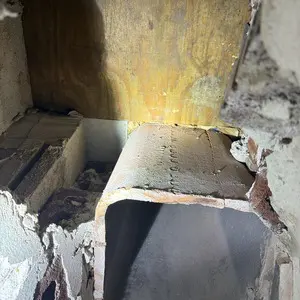
Why This Condition Stays Hidden
This problem is easy to miss because it sits below the fireplace, not on it. From the living room, the brick, stone, or tile on top can look perfectly sound.
In most cases, technicians find it only when they open the fireplace or reach the space underneath. On this project, they reached the hidden area through the ash pit.
Why Does a Hearth Need Non-Combustible Support?
A hearth needs non-combustible support because it sits right next to repeated fireplace heat. What holds the hearth up matters as much as the finish you see on top.
That is why removing the wood is only half the job. After the forms came out, our crew grouted the openings so the hearth could rest on non-combustible support again.
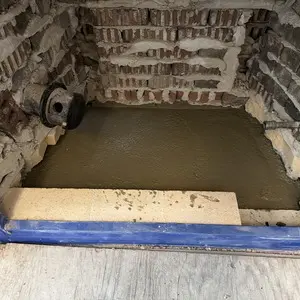
Removal and Restoration Go Together
Pulling out hidden wood leaves gaps in the structure below the hearth. Those gaps need to be filled with the right material before the fireplace goes back into service.
In short, restoration matters just as much as demolition. A repair that skips this step can leave the hearth without proper support.
Project-specific finding: On this Glencoe job, the fireplace was not to be used until the wood-below-hearth repair was complete. That instruction applied to this home’s documented condition. Your fireplace needs its own chimney inspection before anyone can say whether it is safe to use.
Why Did This Project Also Need a Full Firebox Rebuild?
The firebox rebuild was a separate repair, listed on its own in the project scope. It involved removing and replacing all the refractory bricks that make up the firebox.
The firebox and the hearth do different jobs. The firebox holds the active fire. The hearth and its support protect the floor area beneath and in front of it. For that reason, fixing one does not fix the other.
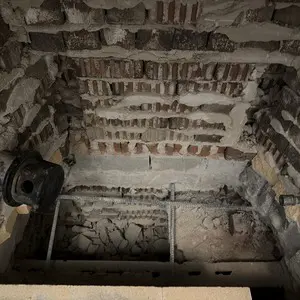
Opening the Firebox for Reconstruction
Before new refractory brick can go in, the old firebox has to come out. This stage shows how much bigger a full rebuild is than a small mortar patch.
Removing refractory brick also creates dust and debris inside the home. For that reason, nearby floors and surfaces are typically protected so the work stays focused around the fireplace.
What Does a Rebuilt Firebox Look Like?
A rebuilt firebox is new refractory-brick construction, not a surface coating over old damage. The full brick assembly inside the fireplace opening is replaced.
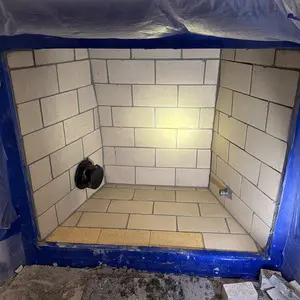
From Demolition to New Refractory Brick
Comparing the demolition photo with the finished firebox makes the scope of the repair easy to see. Both photos come from this Glencoe project, not from a stock image.
If you notice cracked, loose, or missing firebox brick at home, our chimney and fireplace repair team can evaluate whether a repair or a full rebuild makes sense.
How Do the Firebox, Smoke Chamber, and Flue Work Together?
A masonry fireplace works as one connected system: firebox, smoke chamber, then flue. The fire burns in the firebox. Above it, the smoke chamber funnels smoke and gases into the flue. Finally, the flue carries them up and out of the chimney.
This project touched all three areas. Along with the firebox rebuild, the scope included smoke chamber parging and stainless-steel liner work.
- Smoke chamber parging uses refractory material to seal gaps and smooth the stepped masonry above the firebox. For a closer look, see our smoke chamber repair project in Vernon Hills.
- A stainless-steel liner creates a continuous vent path from the smoke chamber to the top of the chimney. Learn more about chimney liner repair and relining.
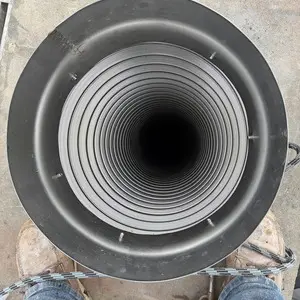
Relining the Fireplace Flue
Once a liner is installed, it disappears inside the chimney. Homeowners rarely see it again.
That is why photos taken during installation matter. They document major internal chimney work before everything is closed up.
Why Can One Fireplace Project Include Several Repairs?
One fireplace project can include several repairs when an inspection finds separate problems in different parts of the system. Here, that meant hidden construction, refractory masonry, venting, and exterior access.
Even so, each repair should match a documented condition. It should not be bundled into one generic “fireplace repair.”
Project Components at a Glance
| Area | Documented work |
|---|---|
| Below the hearth | Removal of combustible wood forms and restoration of non-combustible support |
| Firebox | Removal and replacement of the refractory-brick firebox |
| Smoke chamber | Parging with refractory material |
| Flue | Stainless-steel fireplace liner installation |
| Exterior access | Specialized safe-access setup where needed |
Why Is Safe Access Part of Major Chimney Work?
Safe access becomes part of the job when repairs reach above the roofline as well as inside the home. Liner work, for example, often requires crews to move between the fireplace and the chimney top.
Depending on the home, the access setup may involve specialized climbing equipment, extra ladders, platforms, or scaffolding. The exact setup depends on the property and the work area.
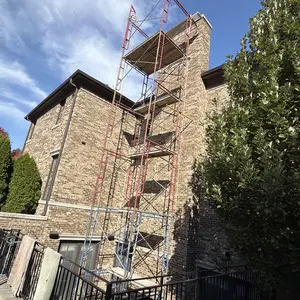
Access Is Planned, Not Added On
The scaffolding on this job shows the scale of the work. Planning access early helps the crew complete the approved repairs safely.
As a result, access is treated as part of the project plan rather than an unrelated extra.
How Does Wood Below Hearth Removal in Glencoe Work, Step by Step?
Wood below hearth removal generally follows six steps, from confirming the condition to reviewing the finished fireplace. The exact order depends on how the fireplace was built and how the hidden area can be reached.
- Confirm the condition. Technicians identify the hidden material and the fireplace construction around it.
- Create access. The crew reaches the hidden area through a suitable opening, such as the ash pit used here.
- Remove the forms. All combustible wood or plywood form material comes out from beneath the hearth.
- Restore the support. The opened areas are grouted to restore non-combustible hearth support.
- Complete related repairs. Approved firebox, smoke chamber, or venting work continues once the support is fixed.
- Review the system. The finished fireplace is checked after the full repair scope is complete.
What Should You Ask If Wood Is Found Below Your Hearth?
Ask five questions: where the wood is, how crews will reach it, how support will be restored, whether the firebox needs work, and when you can use the fireplace again.
- Where exactly is the combustible material? Ask where it sits in relation to the hearth, firebox, and nearby framing.
- How will technicians reach it? Access might come through an ash pit, a basement wall, the firebox, or another opening.
- How will non-combustible support be restored? Ask what material and method will support the hearth once the wood is gone.
- Does the firebox need its own repair? These are separate conditions, so confirm whether the firebox also needs work.
- When can the fireplace return to service? Follow the guidance tied to your actual repair. Don’t assume you can light a fire right away.
Frequently Asked Questions
What is wood below the hearth?
It usually means combustible form boards or framing left under a masonry hearth after construction. Because that space is hidden, it often takes an inspection or repair access to confirm the condition. The finished hearth on top can look completely normal.
Why would wood be under a masonry hearth?
Builders sometimes use wood as temporary formwork while pouring or laying a hearth. The problem starts when those forms stay in place after construction. The International Residential Code calls for combustible forms to be removed once the hearth is complete.
Can I see wood below my hearth myself?
Usually not. The wood sits beneath the finished hearth, so it is rarely visible from the room. In some homes, part of the area can be seen from a basement or ash pit. A professional chimney inspection is the reliable way to confirm it.
Does wood below the hearth mean the firebox needs rebuilding?
No. The firebox and the hearth support are separate parts of the fireplace. Each one should be evaluated on its own before deciding the repair scope. This Glencoe project needed both repairs, but that will not be true in every home.
How do technicians remove hidden wood below a hearth?
The method depends on how the fireplace was built. On this Glencoe project, the crew reached the area through the ash pit, removed the plywood forms, and grouted the openings afterward. That restored non-combustible support under the hearth.
Can I use my fireplace before the repair?
Follow the guidance given for the documented condition in your home. On this specific project, the fireplace was not to be used until the wood-below-hearth repair was finished. If you suspect a similar issue, have the fireplace inspected before your next fire.
Professional Wood Below Hearth Removal in Glencoe
Some of the most important fireplace problems stay hidden during normal use. Wood left under a masonry hearth is a clear example, because the visible fireplace reveals little about what lies beneath it.
This project addressed several parts of the system. The work covered hidden wood-form removal, restored non-combustible support, a full firebox rebuild, smoke chamber parging, stainless-steel relining, and safe access.
Chimney Monkey serves homeowners in Glencoe and across the North Shore. A professional evaluation helps separate each condition and shows what every part of your fireplace and chimney actually needs.
Not sure what service your home needs? Start with a professional evaluation so the system can be identified, the visible conditions can be documented, and the right next step can be recommended.
Have a question about your chimney, fireplace, venting system, gutters, or dryer vent? Schedule a professional visit and get clear recommendations based on the actual condition of your home.
Categories: Chimney Care Chimney Inspection Cook County Illinois Fireplace Mantel Fireplace Services Glencoe