
Inside a Vernon Hills Smoke Chamber Repair, Flue Reline, and Crown Rebuild
Smoke chamber repair seals the gaps, cracks, and rough corbeled brick above a fireplace’s firebox. As a result, it helps the fireplace draft properly and keeps heat away from nearby framing. Chimney Monkey is a National Fireplace Institute–affiliated company rated 4.9 stars across more than 1,100 reviews. In this Vernon Hills project, our crew completed the repair on a two-story fireplace in Vernon Hills, IL, along with a new flue liner, a rebuilt chimney crown, and a repainted firebox interior.
This post walks through what the repair involved, why it so often comes bundled with liner and crown work, and what to expect if a technician recommends the same thing for your fireplace. Last updated September 2026.
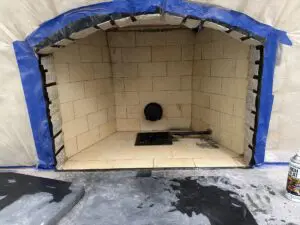 What Is Smoke Chamber Parging, and Why Does It Matter?
Smoke chamber parging coats the interior brick of the smoke chamber with a smooth layer of refractory material. The smoke chamber is the funnel-shaped area between the top of the firebox and the bottom of the flue. For example, builders often leave this space as rough, stepped brick, called corbeling, since it sits out of sight above the damper. That rough surface can leave gaps, cracks, and holes. Consequently, heat and flue gases can reach nearby wood framing through those openings, whether they developed during construction or after years of use.
Parging fills the gaps and smooths the stepped brick into one continuous surface. A smoother chamber helps flue gases move upward instead of catching on ledges. In addition, the parging closes off points where heat could transfer into the surrounding framing. Chimney inspectors trained through the Chimney Safety Institute of America check this directly. For instance, a standard Level 2 masonry fireplace inspection asks whether “the smoke chamber walls [are] parged smooth” as part of evaluating the whole system.1
The National Fire Protection Association’s NFPA 211 covers chimneys, fireplaces, vents, and solid fuel–burning appliances. Moreover, it addresses this same part of the system as part of its safety requirements. However, code editions and section numbers change over time. Therefore, always confirm current requirements against the edition your local jurisdiction has adopted.
 What This Smoke Chamber Repair Job Involved in Vernon Hills
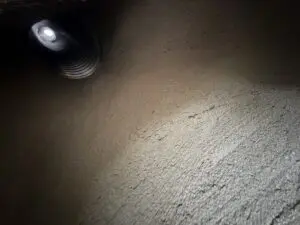 What This Smoke Chamber Repair Job Involved in Vernon Hills
This fireplace needed more than a spot repair. Once our technician had access to the area above the damper, the full scope of work included:
- Parging — the crew removed the damper and its frame to reach the space above it, then sealed gaps, cracks, and rough corbeled brick with refractory parging material.
- Flue liner installation — the crew installed a continuous, water- and gas-tight stainless steel liner, about 11 inches in diameter and roughly 23 feet long, from the top of that area to the top of the chimney, with a new top tile and rain cap to match.
- Firebox refinishing — the crew repainted the firebox interior with high-temperature black fireplace paint for a uniform, finished appearance.
- Chimney crown rebuild — the crew removed the existing crown and formed a new concrete crown with proper slope, an expansion joint around the flue tile, and a drip edge to shed water away from the structure.
- Professional roof access — the work required sustained time at the chimney top, so the crew set up scaffolding rather than relying on a single extension ladder.
The crew completed and signed off on all of this work in a single visit. In fact, flue liner work and crown replacement are common companions to this kind of repair. A technician who already has safe access to the flue opening can address all three areas in one trip. As a result, the homeowner avoids scheduling separate visits later.
Why This Kind of Damage Rarely Shows Up Alone
A damaged smoke chamber often signals that other parts of the same system need a look. The chimney crown sits directly above the same flue that space feeds into. Cracks in one area frequently coincide with deterioration in the other. If your technician confirms damage here, expect a thorough check of:
- The existing flue liner or tile. Damage in this area sometimes points to a liner that also needs repair or replacement.
- The chimney crown and surrounding masonry. Water intrusion at the top of the chimney can travel down and worsen cracking over time. Crews often recommend masonry repair alongside crown work.
- The damper and its frame. Technicians remove these for access and may need to adjust or replace them, depending on their condition.
- The firebox itself. Soot staining or heat damage can suggest poor drafting over time. A broader chimney and fireplace repair evaluation confirms the full scope before work begins.
Therefore, a thorough chimney inspection should always come before scheduling repair work. It identifies which related issues actually exist, rather than guessing from a single symptom.
How Professionals Access and Complete This Kind of Repair
Reaching the work area starts inside the fireplace. First, a technician removes the damper and its frame to open a path upward. By contrast, access to the top of the flue for liner and crown work comes from the roof. Therefore, taller or steeper chimneys often need more than a single ladder. On this job, the crew used a multi-section scaffolding tower secured against the house. That setup let them reach a two-story chimney safely, rather than working from an extension ladder alone.
A combined project like this one generally follows this sequence:
- Remove the damper and frame to access and inspect the area above it.
- Apply refractory parging material to seal gaps and smooth corbeled brick.
- Set up roof access equipment sized to the chimney’s height and pitch.
- Remove the old crown and any damaged flue tile at the top of the chimney.
- Install the new liner and insulation, then form and finish the new crown around it.
- Reinstall the damper, fit a rain cap sized to the new liner, and do a final visual check.
However, not every job needs every step. For example, a chamber in otherwise good condition might only need parging. Conversely, a chimney with a sound chamber but a failing liner might skip that portion entirely. For this reason, an inspection should come before a fixed repair plan.
Typical Cost Range for Smoke Chamber Repair and Related Work
Exact pricing depends on chimney height, access difficulty, and the materials involved. The figures below are general market ranges, not a quote for any specific home:
| Service | Typical Range | What Affects the Price |
|---|---|---|
| Smoke chamber parging | Roughly $1,200–$2,800 | Size of the area and extent of gaps or damage |
| Flue liner installation | Often priced per linear foot, commonly $200–$350 per foot | Liner diameter, chimney height, and insulation type |
| Chimney crown rebuild | Roughly $1,800–$3,800 | Chimney size (common vs. large) and existing damage |
| Firebox repainting | Roughly $150–$400 | Firebox size and prep work needed |
| Specialized roof access | Roughly $300–$900 | Chimney height, roof pitch, and equipment required |
These ranges reflect general market pricing for the Chicago North Shore area. They are not a quote. A firm price requires an on-site or photo-based evaluation of your specific chimney.
Signs Your Fireplace May Need the Same Kind of Attention
A few warning signs are worth having evaluated:
- Smoke that backs up into the room instead of drafting cleanly up the flue.
- Visible gaps, cracks, or crumbling mortar when looking up past the damper with a flashlight.
- A chimney crown with visible cracks, since crown damage often appears alongside this issue.
- A musty or smoky odor between fires, which can point to air leaking through hidden gaps.
- No documented Level 2 inspection on file, particularly for an older home.
Any one of these signs is worth a look. More importantly, several together suggest that the chamber, liner, and crown should all be evaluated in the same visit, as they were during this Vernon Hills job.
Frequently Asked Questions
What is smoke chamber parging?
Smoke chamber parging coats the interior brick of the smoke chamber, the funnel-shaped area above the firebox, with a smooth layer of refractory material. As a result, it closes gaps and cracks and smooths rough corbeled brick so the area functions and drafts as intended.
Does a routine chimney sweep fix this kind of damage?
No. A chimney sweep removes soot and creosote. Although a technician may note damage during that visit, cleaning does not repair cracks, gaps, or rough brick. Instead, those defects need parging or masonry repair as a separate service.
Can I still use my fireplace before this repair is done?
That depends on what an inspection finds. While minor wear may not stop safe use in the short term, active gaps or cracks near combustible framing are a reason to hold off until a qualified technician evaluates the condition. When in doubt, ask the technician who inspected your chimney directly.
How do I know if my fireplace needs this repair?
Warning signs include smoke backing up into the room, visible gaps or cracks above the damper, and a chimney crown that already shows cracking. A professional inspection is the only reliable way to confirm the condition, since most of this area is hidden from view.
Why did this job also include a new flue liner?
Damage here and a worn or undersized liner often show up together, since both sit along the same flue pathway. In addition, once a technician has safe access to the chimney top, addressing the liner in the same visit avoids a second full setup later.
Will I need a new damper after this kind of repair?
Not always. Technicians typically remove the existing damper and frame for access, then reinstall them. However, a new damper is needed if the original is missing, damaged, or can’t be safely reinstalled. The crew identifies that during the work rather than assuming it beforehand.
How long does a project like this take?
A combined project with a liner and crown is typically finished in a single day once access equipment is in place, though weather and chimney height can extend that. By comparison, parging alone is usually a shorter visit when liner or crown work is not required.
How much does smoke chamber repair typically cost?
Parging alone typically runs $1,200–$2,800 depending on the extent of the damage. By contrast, a combined project with a new liner and crown costs more. See the cost section above for a fuller breakdown, and request an on-site evaluation for an exact figure.
Not sure what service your home needs? Start with a professional evaluation so the system can be identified, the visible conditions can be documented, and the right next step can be recommended.
Have a question about your chimney, fireplace, venting system, gutters, or dryer vent? Schedule a professional visit and get clear recommendations based on the actual condition of your home.
1 Chimney Safety Institute of America, Level 2 Inspection Checklist for a Masonry Fireplace (accessed September 2026).
Categories: Masonry Chimney Repair