
A Glenview Customer Asks: Can I Use My Fireplace If the Firebox Has Cracks?
A Glenview homeowner recently asked us a simple question: “Can I use my fireplace if the firebox has cracks?”
It’s a fair question because not every firebox crack means the same thing. A small hairline crack in some factory-built refractory panels may be normal. However, loose firebrick, missing mortar, crumbling refractory, large gaps, or exposed metal point to completely different conditions.
So, how can you tell what you’re looking at?
More importantly, when should you stop guessing and schedule an inspection?
⚡ Quick Answer: A hairline crack does not automatically mean your fireplace is unsafe. Some factory-built fireplace manufacturers consider minor refractory cracking normal. However, if the firebox starts crumbling, bricks become loose, mortar disappears, gaps open, or metal shows behind a refractory panel, stop using the fireplace and schedule an inspection.
Firebox Cracks: At a Glance
| What You See | What It May Mean | Next Step |
|---|---|---|
| Fine hairline crack in a refractory panel | Expansion and contraction may cause minor cracking | Check the fireplace model and manufacturer guidance |
| Cracked or missing mortar between firebricks | Firebox mortar deterioration | Firebox tuckpointing may help |
| Cracked or loose firebrick | Damage extends beyond the mortar joint | Firebrick repair or replacement may be needed |
| Crumbling refractory or missing pieces | The firebox lining is deteriorating | Stop using the fireplace and schedule an inspection |
| Metal showing behind a refractory panel | The panel no longer fully covers the firebox | Stop using the fireplace and schedule service |
What Is the Firebox?
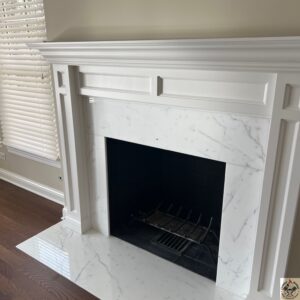
The firebox is the area inside your fireplace where the fire actually burns.
It includes the floor, back wall, and side walls immediately surrounding the fire. Because this area takes direct heat, manufacturers and masons use materials designed for high-temperature conditions.
In a masonry fireplace, the firebox usually contains individual firebricks and heat-resistant mortar.
By contrast, a factory-built fireplace may use molded refractory panels inside a metal fireplace system.
That difference matters. After all, a crack in firebrick, a crack in mortar, and a crack in a refractory panel do not automatically indicate the same problem.
Are Hairline Cracks in a Firebox Normal?
Sometimes, yes.
For example, some factory-built fireplace manufacturers explain that small hairline cracks can develop in refractory panels as the material expands and contracts during fireplace use.
In those specific systems, a fine surface crack may not affect fireplace performance or safety.
However, one important detail changes the answer:
The manufacturer’s guidance applies to specific fireplaces and specific components.
Therefore, you cannot assume that every crack in every firebox is normal.
A masonry firebox with deteriorated mortar differs from a molded refractory panel. Likewise, a thin surface line differs from a panel that has started crumbling or losing pieces.
Instead of asking only, “Is there a crack?” ask a better question:
What exactly is cracked?
✅ Signs a Small Firebox Crack May Be Less Serious
A small crack may deserve a different response when:
- ✅ The crack looks like a fine surface line
- ✅ The refractory panel remains solid
- ✅ No pieces are loose or missing
- ✅ No metal shows behind the refractory
- ✅ Large gaps have not opened between panels
- ✅ The fireplace manufacturer allows minor refractory cracking
In this situation, you still need to identify the crack correctly.
However, a fine hairline crack in an otherwise intact refractory panel does not represent the same condition as a deteriorating firebox.
As a result, the overall condition of the material matters just as much as the visible line.
⚠️ Signs You Should Stop Using the Fireplace
Firebox damage becomes more concerning when the condition goes beyond a fine surface crack.
For instance, watch for:
- ⚠️ Crumbling or deteriorating refractory material
- ⚠️ Large pieces of a refractory panel breaking away
- ⚠️ Metal showing behind the refractory panel
- ⚠️ Loose or missing firebricks
- ⚠️ Open or missing mortar joints
- ⚠️ Large gaps between firebox materials
- ⚠️ Cracks that appear to get wider
- ⚠️ Several damaged areas inside the firebox
If you see these conditions, do not keep lighting fires to “see if it gets worse.”
Instead, stop using the fireplace and have someone evaluate the firebox before you light another fire.
Masonry Firebox vs. Factory-Built Fireplace
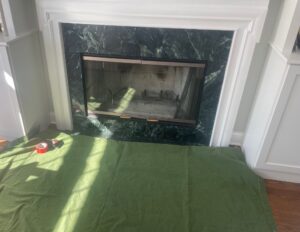
This is where many homeowners get confused.
At first glance, the inside of two fireplaces may look similar. Nevertheless, the correct repair can differ completely.
Masonry Firebox
A masonry firebox typically uses individual firebricks with mortar joints between them.
Over time, homeowners may notice:
- Crumbling mortar
- Missing mortar between firebricks
- Open joints
- Loose firebrick
- Cracked firebrick
If the bricks remain in good condition but the mortar joints deteriorate, firebox tuckpointing may be the right repair.
During firebox tuckpointing, a technician removes loose or deteriorated mortar and replaces it with mortar intended for high-temperature firebox conditions.
However, tuckpointing only addresses mortar-joint problems. If the firebrick itself has failed, the firebox may need a different repair.
Factory-Built Fireplace
A factory-built fireplace may use molded refractory panels inside a metal firebox.
These panels belong to a specific fireplace system. Therefore, the manufacturer and model matter.
Some manufacturers consider minor hairline cracks normal. However, those same manufacturers may call for replacement when cracks grow too large, material falls out, or metal becomes visible behind the refractory.
In that case, identifying the fireplace system becomes the first step.
A masonry repair should not automatically go onto a factory-built refractory panel. Instead, the repair needs to match the fireplace and its components.
What About the 1/4-Inch Firebox Crack Rule?
You may have seen a 1/4-inch crack measurement while researching fireplace firebox cracks online.
Some fireplace manufacturer manuals use a 1/4-inch, or 6-millimeter, crack width as a replacement threshold for specific refractory panels.
However, the 1/4-inch measurement is not a universal rule for every fireplace.
For example, a masonry firebox does not automatically follow the same standard as a factory-built refractory panel. Another factory-built fireplace may also use different manufacturer instructions.
Therefore, do not measure a crack, compare it with a random answer online, and assume the fireplace is safe.
First, identify the fireplace.
Then, evaluate the actual damage.
Finally, compare the condition with the requirements for that fireplace system.
Can a Cracked Firebox Be Repaired?
Often, yes.
However, the correct repair depends on the damaged material.
If mortar between masonry firebricks deteriorates, firebox tuckpointing may restore the joints.
On the other hand, a loose or damaged firebrick may need repair or replacement.
A factory-built refractory panel creates another situation. If that panel seriously deteriorates, the fireplace may need the correct replacement panel for that specific system.
The key difference is simple:
Mortar damage, brick damage, and refractory panel damage require different answers.
Because of that, a tube of generic “fireplace crack repair” material is not automatically the correct solution for every firebox crack.
Why This Question Comes Up So Often in Glenview
Fireplace concerns often start when a homeowner notices one small change.
Perhaps a crack was not obvious last winter. Now, the line stands out.
Maybe the fireplace has not been used for months. Then, before the first fire of the season, someone looks inside and notices a gap or damaged mortar.
Homes throughout Glenview and Chicago’s North Shore also contain different types of fireplaces. We see traditional masonry fireboxes as well as factory-built fireplace systems.
Therefore, the same question can lead to two very different answers.
The goal is not to scare a homeowner over every line inside the firebox.
Instead, the goal is to figure out what that line actually is.
Frequently Asked Questions
Can I use my fireplace if the firebox has a crack?
It depends on the fireplace and the type of crack. Some factory-built fireplace manufacturers consider minor hairline cracks in refractory panels normal. However, crumbling material, loose firebrick, missing mortar, large gaps, or exposed metal deserve closer attention. In those cases, stop using the fireplace until someone evaluates the firebox.
Are hairline cracks in a fireplace firebox normal?
Small hairline cracks may be normal in some factory-built refractory panels. Because heating and cooling cause expansion and contraction, minor cracks can develop over time. However, manufacturer requirements vary, so the fireplace type and model still matter.
How wide is too wide for a firebox crack?
There is no single crack-width rule for every fireplace. Some manufacturer manuals use 1/4 inch, or 6 millimeters, as a replacement threshold for specific refractory panels. However, that measurement does not automatically apply to every fireplace.
Can cracked firebox mortar be repaired?
Yes. If the mortar joints between masonry firebricks deteriorate, firebox tuckpointing may be an appropriate repair. First, the firebox needs an evaluation to confirm that the mortar joints are the actual problem.
Does a cracked firebox mean I need a new fireplace?
No. A firebox crack does not automatically mean you need a new fireplace. Depending on the damage, the repair may involve tuckpointing, replacing damaged firebrick, or replacing a refractory panel.
Should I stop using my fireplace if the firebox is crumbling?
Yes. If refractory material crumbles, pieces go missing, metal becomes visible, or firebricks loosen, stop using the fireplace. Then, schedule an inspection before you light another fire.
Serving Glenview and the Surrounding Communities
Chimney Monkey is based at 741 Hastings Dr in Buffalo Grove and helps homeowners throughout Glenview and Chicago’s North Shore inspect fireplace and firebox concerns.
We also serve Deerfield, Northbrook, Wilmette, Winnetka, Lake Forest, Lake Bluff, Skokie, Evanston, and Park Ridge.
Not sure what kind of crack you’re looking at?
Get a straight answer about the firebox, not a guess.
Not sure what the crack inside your firebox means?
Have the fireplace evaluated before a small concern turns into a bigger question.
Categories: Chimney Care Chimney Inspection Cook County Illinois Glenview Local Services Masonry Chimney Repair