
Two-Chimney Crown and Flashing Restoration in Inverness
Last updated: · By the Chimney Monkey team
This chimney restoration in Inverness covered two masonry chimneys on one home, and each chimney received its own set of exterior repairs. Chimney Monkey rebuilt both crowns, replaced flashing, washed and waterproofed both chimneys, tuckpointed one chimney and installed a stainless steel rain cap. We are an NCSG member company with NFI-certified technicians, a 4.9-star Google rating and more than 1,100 reviews.
Short answer
In August 2026, Chimney Monkey restored two chimneys on an Inverness, IL home. Both chimneys received full concrete crown rebuilds and a wash with waterproofing. The project also included flashing replacement, tuckpointing and a new stainless steel rain cap. Each part now handles a different job in keeping water out.
In this recap
What did this two-chimney restoration in Inverness include?
The project split into two scopes, one for each chimney, and both scopes centered on a full crown rebuild.
Chimney A
- ✓ Full concrete crown rebuild
- ✓ Flashing replacement
- ✓ Chimney wash and waterproofing
- ✓ Safe-access equipment
Chimney B
- ✓ Full concrete crown rebuild
- ✓ Stainless steel rain cap
- ✓ Tuckpointing
- ✓ Chimney wash and waterproofing
- ✓ Safe-access equipment
Because each chimney had different needs, the crew treated them as two separate jobs on the same roof. In addition, both chimneys required safe-access equipment, since the crowns sit well above the roofline.
Why did both chimneys need new crowns?
Both chimneys received full crown rebuilds, which replace the old crown entirely instead of patching it.
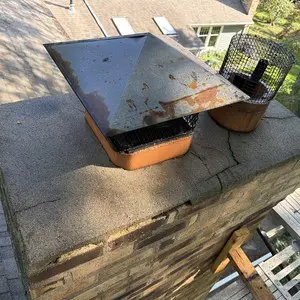
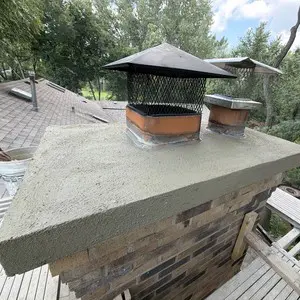
The crown is the concrete slab that covers the top of a masonry chimney. On the first chimney, the old crown showed visible cracks across its surface. For that reason, the crew removed it and formed a new concrete crown sized for a common masonry chimney.
Each new crown has a proper slope, an expansion joint around the flue tile and an overhanging drip edge. Together, these features move water off the top and away from the brick. Our chimney crown repair and replacement page explains when a crown can be repaired and when it needs replacing.
The second chimney crown
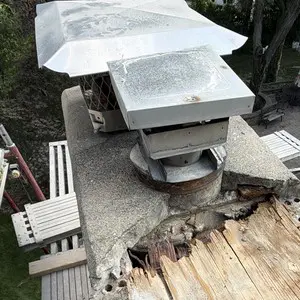
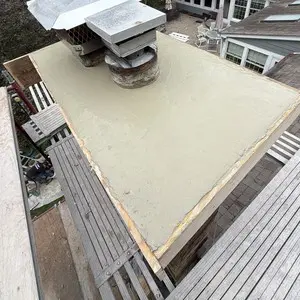
The second chimney followed the same process. First, the crew removed the deteriorated crown, which had broken down along its edges. Next, they built wood forms around the top and poured a new concrete crown with the same slope, joint and drip edge. Crown work is weather-dependent, because new concrete needs time to cure.
What job does each part of a chimney do?
Each exterior part of a chimney handles water in its own way, so one part cannot stand in for another.
| Part | Its job | What it does not do |
|---|---|---|
| Crown | Sheds water off the top of the masonry | It does not seal the roof-to-chimney joint |
| Flashing | Seals the joint where the chimney meets the roof | It does not protect the top of the chimney |
| Rain cap | Covers the flue opening against rain, debris and animals | It does not replace the crown |
| Mortar joints | Hold the brick together and resist water | Worn joints are not fixed by waterproofing |
| Waterproofing | Limits how much water the masonry absorbs | It does not repair failed mortar |
That is why this project combined several repairs. For example, a new crown helps little if water still enters at the roofline. Likewise, waterproofing works best on sound mortar joints.
Why was the chimney flashing replaced?
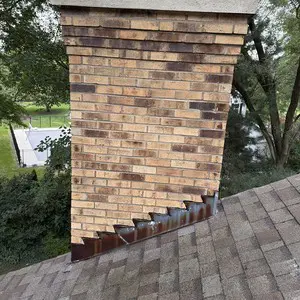
Flashing replacement addresses damaged or improperly installed flashing at the roof-to-chimney transition.
Flashing is the metal that bridges the gap between the chimney and the roofing. It protects one of the most common leak points on a roof. On this project, the invoice lists flashing replacement as two units within the Chimney A scope.
The work also includes cleaning the flashing area and applying sealants where the chimney and roof meet. See our chimney flashing repair page for more.
What do tuckpointing and waterproofing add?
Tuckpointing renews worn mortar joints, while waterproofing protects the masonry after the joints are sound.
On Chimney B, the crew removed deteriorated or loose mortar and installed new mortar to restore proper joint depth. They also blended the finish with the existing brick. Learn more on our tuckpointing page.
Afterward, both chimneys were washed to remove surface grime and growth. The crew then applied a vapor-permeable waterproofing treatment that limits water absorption while still letting moisture vapor escape. Cleaning reduces buildup, although it cannot promise to remove every old stain. See our chimney waterproofing page for details.
Remember: waterproofing does not repair failed mortar. Worn joints need tuckpointing first, so the treatment has sound masonry to protect.
Why add a stainless steel rain cap?
A rain cap covers the flue opening, while the crown covers the masonry around it.
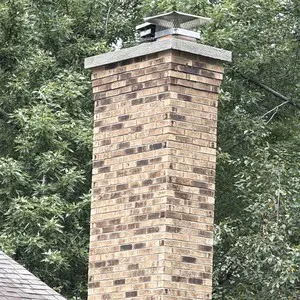
On Chimney B, the crew fitted and installed a standard 9×9 stainless steel rain cap with a spark arrestor screen. It helps keep rain, snow, debris, birds and animals out of the flue. The cap carries a lifetime warranty.
Even so, a cap is not a substitute for a crown. Both parts work together at the top of the chimney. Visit our chimney cap installation page to learn more.
How did this chimney restoration come together?
The crew worked from the top of each chimney down, then finished with the protective treatments.
Set up safe access
They staged equipment to reach both chimneys safely.
Remove old crowns
Both worn crowns came off the chimneys.
Pour two crowns
New sloped crowns went into wood forms on each chimney.
Flashing and mortar
Flashing was replaced, and Chimney B was tuckpointed.
Wash and waterproof
Both chimneys were cleaned and treated.
Install the cap
A stainless rain cap went on Chimney B.
Typical sequence: mortar repairs come before waterproofing, so the treatment protects sound joints.
Why does this project matter for Inverness homes?
Chimney Monkey serves Inverness from our base in Buffalo Grove, along with Chicago, the North Shore and the northwest suburbs.
Homes with two chimneys often need a different plan for each one, as this project shows. Therefore, we look at the crown, flashing, cap and mortar on every chimney separately. If you are not sure what your chimneys need, a chimney inspection is the best first step.
Signs your chimney exterior may need attention
- Cracks or crumbling edges on the crown
- Rusty, loose or missing flashing at the roofline
- Mortar joints that look recessed or sandy
- A missing or damaged rain cap
- Water stains near the chimney inside the home
Two-chimney restoration FAQs
Why would two chimneys on one house need different repairs?
Each chimney has its own crown, flashing, cap and mortar, and each one wears differently. In this Inverness project, both chimneys received new crowns and waterproofing. However, only one received tuckpointing and a new rain cap, while flashing replacement was listed in the other scope.
Does a rain cap replace a chimney crown?
No. A rain cap covers the flue opening, while the crown covers the masonry around it. The cap keeps out rain, debris and animals, and the crown sheds water off the top of the chimney. Most chimneys benefit from both.
Does a new crown fix chimney flashing problems?
No. The crown protects the top of the chimney, while flashing seals the joint where the chimney meets the roof. A leak at the roofline needs flashing work. That is why this project included both crown rebuilds and flashing replacement.
Can waterproofing fix worn mortar joints?
No. Waterproofing limits how much water the masonry absorbs, but it does not repair failed mortar. Worn joints need tuckpointing first. On this project, the crew tuckpointed Chimney B before washing and waterproofing it.
What is a full crown rebuild?
A full crown rebuild removes the existing crown and builds a new concrete one. The new crown has a proper slope, an expansion joint around the flue tile and an overhanging drip edge. Both chimneys in this Inverness project received full crown rebuilds.
What does chimney flashing do?
Flashing is the metal that seals the joint between the chimney and the roofing. It protects one of the most common leak points on a roof. Flashing work includes cleaning the area and applying sealants where the chimney and roof meet.
What does chimney washing and waterproofing involve?
The crew washes the outside masonry to remove grime and growth, using a masonry detergent where needed. Next, they apply a vapor-permeable water repellent. It limits water absorption while still letting moisture vapor escape. Washing cannot promise to remove every old stain.
Why is safe-access equipment needed for chimney work?
Many chimneys rise well above the roofline, so crews need a stable way to reach the top. Safe access can include climbing equipment, platforms, extra ladders or scaffolding. Both chimneys in this Inverness project required safe-access equipment.
Standards referenced
- NFPA 211, Standard for Chimneys, Fireplaces, Vents, and Solid Fuel-Burning Appliances (National Fire Protection Association): annual chimney inspection, with cleaning when the inspection shows it is needed.
- Manufacturer documentation for the stainless steel rain cap and the vapor-permeable masonry water repellent.
Not sure what service your home needs? Start with a professional evaluation so the system can be identified, the visible conditions can be documented, and the right next step can be recommended.
Have a question about your chimney, fireplace, venting system, gutters, or dryer vent? Schedule a professional visit and get clear recommendations based on the actual condition of your home.
Categories: Cook County Illinois Inverness Local Services Masonry Chimney Repair