
Two-Fireplace Restoration and Chimney Relining in Barrington
Last updated: · By the Chimney Monkey team
This fireplace restoration in Barrington covered two fireplaces in one home, and each one needed a different set of repairs. Chimney Monkey relined both flues with stainless steel liners and parged both smoke chambers. The front fireplace also received a full firebox rebuild, while the back fireplace received targeted firebox repairs, hearth extension tuckpointing and a new chimney crown. We are an NCSG member company with NFI-certified technicians, a 4.9-star Google rating and more than 1,100 reviews.
Short answer
In August 2026, Chimney Monkey restored two fireplaces in a Barrington, IL home. Both flues received 22-foot stainless steel liners and smoke chamber parging. The front firebox was fully rebuilt, while the back firebox was repaired, stained black and sealed at its face. The project also included hearth extension tuckpointing and a new concrete crown.
In this recap
Why can two fireplaces in one home need different repairs?
Each fireplace has its own firebox, smoke chamber and flue, so two fireplaces in the same house can wear in very different ways.
In this Barrington home, both fireplaces shared the same core needs: a new liner and smoke chamber parging. However, the condition of each firebox was different. As a result, the front firebox was rebuilt from scratch, while the back firebox only needed targeted repairs.
Front living room
- ✓ 22 ft rectangular stainless steel liner
- ✓ Smoke chamber parging
- ✓ Full firebox rebuild
Back living room
- ✓ 22 ft stainless steel liner, listed as 10-inch
- ✓ Smoke chamber parging
- ✓ Firebox repair and black staining
- ✓ Firebox face sealed
- ✓ Hearth extension tuckpointing
- ✓ Full crown rebuild
Safe-access equipment was part of the job on both scopes, since the crew worked from the roof to install the liners and build the crown.
What did the front living room fireplace need?
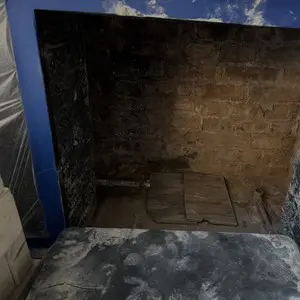
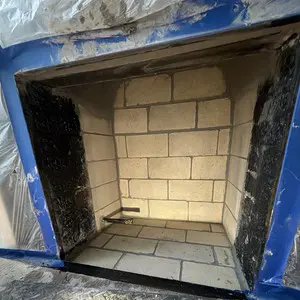
The front living room fireplace received a full firebox rebuild, a 22-foot rectangular stainless steel liner and smoke chamber parging.
A full firebox rebuild means the crew removes and replaces every refractory brick that forms the firebox. Refractory brick, also called firebrick, is made to handle the direct heat of a fire. In this firebox, the old brick came out completely, and new firebrick went in on the back wall, sides and floor.
Before the rebuild, the crew protected the fireplace surround with plastic and tape. That step matters because some facing materials can be fragile. Our masonry repair page covers other brick and mortar work we handle.
How does a full firebox rebuild differ from a targeted firebox repair?
A full rebuild replaces every firebrick, while a targeted repair keeps the sound firebox and fixes only the damaged joints and bricks.
| Repair | What it involves | When it fits |
|---|---|---|
| Full firebox rebuild | Removing and replacing all firebrick in the firebox | The firebox is worn throughout |
| Targeted firebox repair | Tuckpointing joints with refractory mortar and replacing cracked or broken firebrick as needed | Most of the firebox is sound |
| Firebox face seal | Filling the gap at the opening with high-temperature ceramic insulation and refractory mortar | A gap has opened between the firebox and the facing |
This project used both approaches in the same home. Therefore, it shows why a single inspection can lead to two different repair plans.
What else did the back living room fireplace receive?
The back living room fireplace received a targeted firebox repair, black firebrick staining, a firebox face seal and hearth extension tuckpointing, along with its liner and parging.
First, the crew tuckpointed the firebox joints with refractory mortar and replaced cracked or broken firebrick as needed. Next, they stained the firebox black with a firebrick stain for a more uniform look. They also sealed the firebox face by filling the gap at the opening with high-temperature fibered ceramic insulation, then covering it with refractory mortar.
Finally, the crew tuckpointed the hearth extension, the masonry floor area in front of the firebox. They removed deteriorated or loose mortar and installed new mortar to restore proper joint depth. Sound joints help keep this area solid and even. Learn more on our tuckpointing page.
Why reline a fireplace flue with stainless steel?
A stainless steel liner gives the fireplace one continuous flue from the top of the smoke chamber to the top of the chimney.
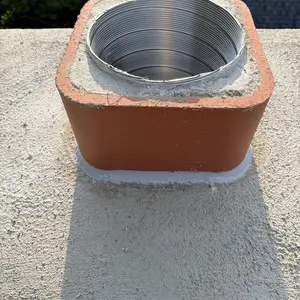
Where needed, the crew breaks out and removes the old clay flue tiles first. Next, they insulate the liner, install it and secure it in the chimney. A new top tile then finishes the flue at the chimney top, as this photo shows.
Both liners in this home ran 22 feet. The front liner is rectangular, and the invoice lists the back liner as 10-inch. See our chimney liner page for more on relining.
What does smoke chamber parging do?
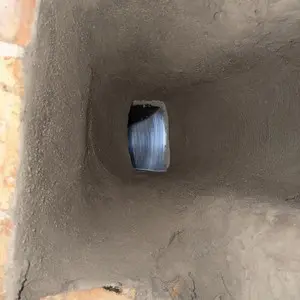
Smoke chamber parging seals gaps, cracks and holes in the smoke chamber with a smooth coat of refractory material.
The smoke chamber is the funnel-shaped space above the firebox that leads into the flue. Its stepped brickwork, called corbelling, can leave rough surfaces and open joints. To reach it, the crew removes the existing damper and frame as needed.
In this home, the crew parged both smoke chambers. As a result, each one now leads smoothly into its new stainless liner, as the photo shows.
Why did the chimney get a new crown?
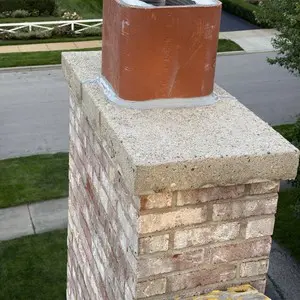
The back living room scope included a full crown rebuild, which replaced the old crown with a new concrete one.
To start, the crew removed the existing crown and formed a new one sized for a common masonry chimney. The new crown has a proper slope, an expansion joint around the flue tile and an overhanging drip edge. Together, these features direct water away from the chimney.
Crown work is weather-dependent, because new concrete needs time to cure. Learn more on our chimney crown repair and replacement page.
How did this two-fireplace restoration come together?
The crew worked from the top of each flue down to the firebox, then finished the exterior with the new crown.
Protect and access
They covered both fireplaces and set up safe access on the roof.
Install two liners
Stainless liners and new top tiles went into both flues.
Parge smoke chambers
Refractory parging sealed both smoke chambers.
Rebuild the front firebox
All firebrick in the front firebox was replaced.
Repair the back firebox
Joints, bricks, black stain, face seal and hearth extension.
Build the crown
A new sloped concrete crown with a drip edge finished the top.
Typical sequence: liner and parging work usually comes before firebox work, so debris from above does not land on new firebrick.
Why does this project matter for Barrington homes?
Chimney Monkey serves Barrington from our base in Buffalo Grove, along with Chicago, the North Shore and the northwest suburbs.
Homes with more than one fireplace often need a separate plan for each one. For that reason, we evaluate every firebox, smoke chamber and flue on its own. If you are not sure what your fireplaces need, a chimney inspection is the best first step. Our chimney repair team can then recommend the right scope.
In this case, each fireplace now has its own new liner and parged smoke chamber. Meanwhile, the firebox repairs match the condition of each firebox rather than a one-size-fits-all plan.
Signs your firebox may need attention
- Cracked, loose or missing firebrick
- Mortar joints that are eroded or open
- A gap between the firebox and the fireplace facing
- Rough or open joints in the smoke chamber
- Loose mortar in the hearth extension
Two-fireplace restoration FAQs
Why would two fireplaces in the same house need different repairs?
Each fireplace has its own firebox, smoke chamber and flue, and each one wears differently. In this Barrington home, both flues received liners and parging. However, the front firebox needed a full rebuild, while the back firebox only needed targeted repairs.
What is a full firebox rebuild?
A full firebox rebuild removes and replaces all of the refractory brick that forms the firebox. It suits a firebox that is worn throughout. On this project, the crew rebuilt the front living room firebox with new firebrick on the back wall, sides and floor.
What is the difference between firebox repair and a full rebuild?
A targeted firebox repair tuckpoints the joints with refractory mortar and replaces cracked or broken bricks as needed. In contrast, a full rebuild replaces every firebrick. The back fireplace in this home received the targeted repair, plus black staining for a uniform look.
What does sealing the firebox face mean?
Sealing the firebox face closes the gap at the fireplace opening, where the firebox meets the facing. The crew fills that gap with high-temperature fibered ceramic insulation, then covers it with high-temperature refractory mortar. This project included a firebox face seal on the back fireplace.
What does smoke chamber parging do?
Parging seals gaps, cracks and holes in the smoke chamber with refractory material and smooths its stepped brickwork. The smoke chamber sits between the firebox and the flue. Both fireplaces in this Barrington home received smoke chamber parging.
Why install a stainless steel liner in a fireplace flue?
A stainless steel liner creates one continuous flue from the smoke chamber to the top of the chimney. The liners in this project carry a manufacturer limited lifetime warranty for the original purchaser. To keep that warranty, the liner needs an annual inspection.
What is a hearth extension, and why tuckpoint it?
The hearth extension is the masonry floor area in front of the firebox opening. Tuckpointing removes loose or deteriorated mortar from its joints and installs new mortar. On this project, the crew tuckpointed the back fireplace hearth extension.
What makes a new chimney crown last?
A lasting crown has a proper slope, an expansion joint around the flue tile and an overhanging drip edge. Together, those features move water off the top and away from the brick. This Barrington chimney received a full crown rebuild with all three features.
Standards referenced
- NFPA 211, Standard for Chimneys, Fireplaces, Vents, and Solid Fuel-Burning Appliances (National Fire Protection Association): annual chimney inspection, with cleaning when the inspection shows it is needed.
- Manufacturer documentation for the installed stainless steel liners.
Not sure what service your home needs? Start with a professional evaluation so the system can be identified, the visible conditions can be documented, and the right next step can be recommended.
Have a question about your chimney, fireplace, venting system, gutters, or dryer vent? Schedule a professional visit and get clear recommendations based on the actual condition of your home.
Categories: Barrington Chimney Care Chimney Exterior Services Cook County Illinois Local Services