
STÛV 30 Wood-Burning Insert in Glencoe: Minimalist Style and Adjustable Heat
Last updated: November 3, 2026
The STÛV 30 wood-burning insert suits Glencoe homes that favor clean architecture and functional design. It pairs minimalist styling with adjustable heat output, and fireplace improvements, upgrades, and enhancements like this one help reinforce that approach. Chimney Monkey has served Chicago’s North Shore since 2017. We are an NCSG member with NFI-certified technicians and a 4.9-star Google rating from more than 1,100 reviews.
The STÛV 30 is a Belgian-designed wood-burning fireplace insert. Its rotating drum switches between a glass door, a solid door, and an open fire. Stûv lists heat output adjustable from 6 to 12 kW for the 30-in version. Whether it fits your Glencoe fireplace depends on firebox size, chimney condition, and venting.
*Figures from Stûv’s published product information for the 30-in ready-to-fit insert. North American models and certifications can differ, so confirm specifications in the installation manual for the exact model.
What is the STÛV 30 wood-burning insert?
The STÛV 30 is a wood-burning insert built around a cylindrical firebox that rotates to change how the fire looks and heats.
The STÛV 30 features a streamlined frame and large glass panel that integrates easily into modern renovations. Its simple proportions allow the fire to remain the visual centerpiece. Stûv, a Belgian manufacturer, designs the 30 series around a pivoting drum. Turning the drum changes the fire from closed and glazed to fully hidden or fully open.
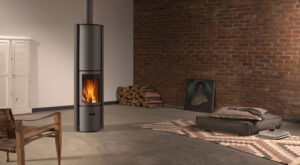
Clean lines and architectural simplicity
A metal structure clads the unit, so the insert reads as one clean shape. Owners can choose from 19 heat-resistant paint colors or a stabilized rust finish. That range lets the insert match a minimalist Glencoe interior or contrast with traditional brick.
How does the STÛV 30 produce and control heat?
The STÛV 30 controls heat through adjustable airflow and three operating modes, with output Stûv lists at 6 to 12 kW.
Controlled airflow and efficient combustion help the insert use wood effectively. Lower settings suit mild evenings, while higher settings support longer burns on cold Chicago nights. Actual room warmth also depends on house layout, insulation, wood moisture, and how the insert is installed.
| Mode | What it does | When owners use it |
|---|---|---|
| Glass door | Shows the flames through the glass while the fire burns closed | Everyday heating with a visible fire |
| Solid door | Closes an insulated panel that cuts radiated heat and hides the firebox | When the fire is out, or to keep the glass clean |
| Open fire | Turns the drum fully open for a traditional fireplace feel | Occasional ambiance, used as the manual allows |
A built-in ash container reduces how often ash needs removal. Stûv also recommends leaving a thin bed of ash to insulate the combustion chamber.
Is the STÛV 30 a good fit for a Glencoe home?
The STÛV 30 fits Glencoe homes best when the owner wants a modern look and the existing fireplace and chimney can support a wood insert.
For Glencoe homeowners looking to elevate both form and function, the STÛV 30 provides a refined fireplace upgrade. Design is only half of the decision, though. Glencoe’s housing stock includes many older masonry fireplaces, and each one has its own firebox size, flue size, and condition.
- Firebox size: the opening must accept the insert and the clearances in its manual.
- Chimney condition: cracked flue tiles or damaged masonry need repair before an insert goes in.
- Liner: most wood inserts vent through a properly sized liner run up the existing chimney.
- Hearth and surround: floor protection and nearby combustibles must meet the manufacturer’s and local requirements.
What does installing a wood-burning insert involve?
Installing a wood-burning insert involves inspecting the fireplace and chimney, sizing the liner, and fitting the unit to the manufacturer’s manual and local code.
- Inspect the system. A chimney inspection checks the firebox, damper, smoke chamber, flue, and exterior masonry.
- Measure and confirm fit. The technician compares firebox and flue dimensions with the insert’s installation manual.
- Plan the venting. Most installs need a stainless steel chimney liner sized to the insert’s flue collar.
- Address repairs. Any masonry, crown, or firebox damage is handled before the insert is set.
- Install and test. Our fireplace installation team sets the insert, connects the liner, and checks draft and clearances.
Signs your fireplace needs an evaluation before an insert
- Smoke spills into the room during fires
- Cracked or missing mortar inside the firebox
- Water stains, rust, or flaking near the damper
- Strong odors from the fireplace in humid weather
- No inspection on record in the past year
Frequently asked questions
How do you evaluate an existing fireplace for a wood insert?
A technician starts with a chimney inspection of the firebox, damper, smoke chamber, flue liner, crown, and exterior masonry. They measure the firebox opening and depth, and the flue size and height. Those findings are compared with the insert’s installation manual. Any cracks, gaps, or water damage are documented so repairs can be planned before installation.
How are venting requirements for a wood insert determined?
Venting requirements come from the insert’s installation manual, NFPA 211, and local code. The manual sets the flue collar size and approved liner types. The technician then confirms chimney height, flue size, and draft. Most wood inserts installed in a masonry chimney need a full-length stainless steel liner connected directly to the insert.
What affects the scope of a wood insert installation?
Scope depends on the fireplace and chimney you already have. A sound chimney with a straight flue usually needs only a liner and the insert. Damaged flue tiles, crown cracks, firebox gaps, or tight clearances add work. Hearth extensions, surround changes, and finish choices can also change the scope and timeline.
Can a STÛV 30 go into any masonry fireplace?
No, not every masonry fireplace can accept it. The firebox must be large enough for the insert and its required clearances. The chimney must also be in good condition and able to hold a correctly sized liner. An inspection and measurements confirm whether a specific fireplace can accept this model or needs a different insert.
Does a wood-burning insert need a chimney liner?
In most cases, yes. Inserts are usually designed to vent through a dedicated liner sized to the flue collar. Older clay tile flues are often too large or damaged for an insert to draft well. A chimney liner helps the insert vent smoke and gases out of the home as designed.
How often should a wood insert be inspected and cleaned?
NFPA 211 calls for a chimney inspection every year. Cleaning is then done when the inspection shows it is needed, based on creosote buildup and use. Homes that burn often through the winter may need a chimney sweep more often than homes that burn a few fires a season.
- Stûv: Stûv 30-in ready-to-fit product information (output range, operating modes, finishes)
- NFPA 211: Standard for Chimneys, Fireplaces, Vents, and Solid Fuel-Burning Appliances (National Fire Protection Association), annual inspection and venting requirements
Proudly serving Chicago’s North Shore
With years of experience and thousands of satisfied customers, our team continues to deliver exceptional chimney care across the North Shore. We’re dedicated to protecting your home year-round while expanding our reach to new towns every season.
Core service areas
We proudly serve Evanston, Wilmette, Kenilworth, Winnetka, Glencoe, Highland Park, Highwood, Lake Forest, Lake Bluff, Deerfield, Riverwoods, Bannockburn, Northfield, and Northbrook.
Extended service areas
We also cover Arlington Heights, Barrington, Buffalo Grove, Des Plaines, Glenview, Hawthorn Woods, and Fort Sheridan. No matter where you live on the North Shore, Chimney Monkey is ready to help.
Not sure what service your home needs? Start with a professional evaluation so the system can be identified, the visible conditions can be documented, and the right next step can be recommended.
Have a question about your chimney, fireplace, venting system, gutters, or dryer vent? Schedule a professional visit and get clear recommendations based on the actual condition of your home.
Categories: Chimney Care Chimney Inspection Cook County Illinois Glencoe Local Services Wood-Burning Insert Installation