
Multi-Chimney Restoration in Northfield: Three Chimneys, Six Fireplace Areas, One Coordinated Plan
By Chimney Monkey · Last updated · Northfield, IL (North Shore) · 9-minute read
Quick answer
This multi-chimney restoration in Northfield, IL rebuilt three exterior chimneys from the roofline up, replaced every crown, resealed flashing, waterproofed the masonry, and added five stainless-steel rain caps. Inside, six fireplace areas received their own smoke-chamber, liner, firebox, or gas-log scope. Overall, each system was repaired according to its condition and purpose.
Chimney Monkey is an NCSG-member chimney and fireplace company based in Buffalo Grove. We hold a 4.9-star rating across more than 1,100 reviews and serve Northfield and the surrounding North Shore. This recap follows a multi-chimney restoration in Northfield from roofline to firebox. Of course, client names and the exact address stay private.
3
Exterior chimneys
Rebuild, crown, flashing, and waterproofing scopes
5
Rain caps
Fitted stainless steel, one per flue termination
6
Fireplace areas
Room-by-room interior and venting work
Multi-Chimney Restoration in Northfield: The Exterior Scope
The exterior work covered three separately documented chimneys, labeled Chimney A, Chimney B, and Chimney C. In addition, each one received its own masonry-rebuild and crown-replacement scope.
The crew followed the same three-step order on each chimney:
- Rebuild the masonry. Deteriorated stone was rebuilt from the roofline up where needed. Suitable original stone stayed in place, and replacement material was matched as closely as possible.
- Install a new crown. Each restored chimney received a new concrete crown sized for that structure.
- Close the moisture paths. Flashing resealing, then washing plus waterproofing, protected the remaining entry points.
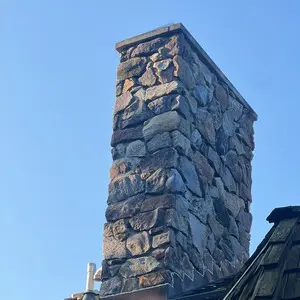
A Large Exterior Restoration Starts With Safe Access
This tall stone chimney sits high above a complex roofline. For this reason, scaffolding and lift equipment were part of the plan.
On a property with several chimneys, access can change from one location to the next. For that reason, the exterior scope accounts for both the masonry repair and the safest way to reach it.
Why Did These Chimneys Need Rebuilding Instead of Spot Repair?
The chimneys needed rebuilding because spalling and crumbling masonry had spread beyond isolated mortar joints. Spalling means the face of brick or stone flakes or pops off, usually after water soaks in and freezes.
Northfield winters bring repeated freeze-thaw cycles, and each cycle can widen cracks in porous stone and mortar. Once damage moves past individual joints, masonry repair such as tuckpointing may no longer hold. A roofline rebuild instead removes material that can no longer stay in service and reconstructs the upper chimney with sound masonry.
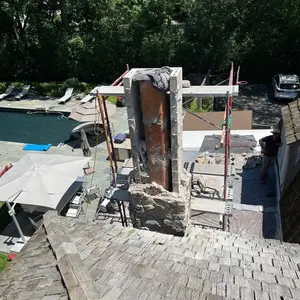
What a True Rebuild Looks Like Mid-Project
Here, much of the damaged upper masonry has been taken down. The remaining flue structure stands exposed while the chimney is rebuilt around it.
In other words, this view shows the difference between a rebuild and a surface fix. Rather than coating over damage, the crew removes it and reconstructs around the existing venting pathway.
How Does Rebuilding Prepare the Chimney Top?
Rebuilding gives the chimney a solid, square base for the crown, flashing, and caps that follow. In fact, without that base, new top components would sit on failing material.
After reconstruction, the chimney again reads as one continuous stone structure. Even so, masonry is only one stage of the restoration. It still depends on the crown, flashing, and water-management details above it to last. Our chimney rebuild and restoration service explains when reconstruction makes more sense than joint repair.
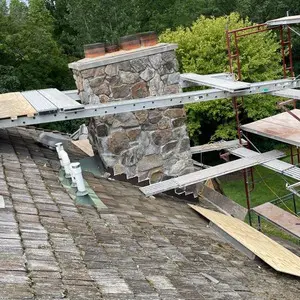
The Restored Stone Structure
Compared with the demolition photo, the rebuilt chimney shows clean, continuous stonework above the roofline.
Equally important, matching the original stone where practical helps the repair blend with the rest of the home.
Why Did Each Chimney Get a New Concrete Crown?
Each chimney got a new crown because a rebuilt chimney needs a properly shaped top to shed water. The crown is the concrete slab that caps the masonry around the flue.
A well-built crown does three jobs. First, its slope moves rain and snowmelt outward. Second, an overhang with a drip edge throws runoff clear of the walls below. Third, a gap around the flue tile lets the tile and concrete expand at different rates without cracking each other.
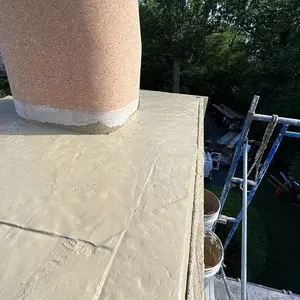
A Close Look at the New Crown
The broad concrete surface reaches past the chimney edge instead of ending flush with the masonry.
That shape is the point. However, a crown is not just cement spread on top of brick or stone; its dimensions are part of the water-management design. Our chimney crown repair and replacement guide compares resurfacing with full reconstruction.
Flashing vs. Waterproofing: Which Water Path Does Each Protect?
Flashing protects the joint where the chimney meets the roof, while waterproofing protects the masonry face itself. Both control moisture, but they guard different parts of the chimney.
Flashing reseal
Metal at the roof-to-chimney transition. Resealing helps keep water from slipping between the shingles and the masonry.
Washing + waterproofing
After cleaning, a vapor-permeable masonry treatment reduces liquid-water absorption while still letting moisture vapor escape.
In short, neither one replaces structural repair. If brick, stone, mortar, or a crown has already failed, it needs repair first. Treatments work best on sound masonry.
What Did the Five Stainless-Steel Rain Caps Add?
The five fitted stainless-steel rain caps cover each flue opening while leaving a clear outlet for exhaust. Additionally, each cap was matched to its own flue termination.
In addition, caps help keep out rain, snow, leaves, birds, and other animals. Because this property has several separate flues, top protection had to be handled flue by flue rather than with one universal part.
Why Did Different Flues Get Different Stainless-Steel Liners?
Different flues got different liners because each one vents a different appliance or fireplace. A flue liner is the inner channel that carries smoke or exhaust safely up and out of the chimney.
Not every flue here served a fireplace. One received a 5-inch stainless-steel utility liner for heating-appliance venting. Specifically, it runs as a continuous path from the appliance vent connectors to the chimney top. Meanwhile, the fireplace flues received larger 11- and 12-inch liners that start at the smoke-chamber area and rise through their chimneys.
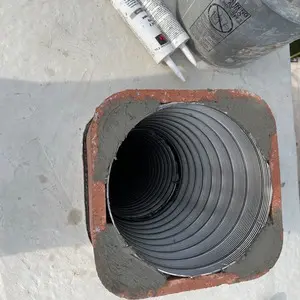
The Liner Creates a Defined Interior Passage
Most of a liner disappears inside the chimney once it is installed. That is why project photos matter for relining work.
They document a part homeowners usually cannot see from the fireplace opening or the mechanical room. Homeowners with heating-appliance flues can review our utility and furnace flue liner installation service.
What Interior Fireplace Work Was Done in Each Room?
Each of the six fireplace areas received its own scope based on its condition and use. Instead of one repair applied everywhere, the work combined smoke-chamber repair, relining, firebox rebuilding, gas-log work, and upgrades room by room.
| Area | Documented scope |
|---|---|
| Office | Smoke-chamber parging, 11-inch fireplace liner, and 18-inch vented gas-log installation |
| Large patio fireplace | Full firebox rebuild, smoke-chamber work, 11-inch fireplace liner, gas shutoff valve, 24-inch gas logs, and exterior wall and limestone repair |
| Kitchen | Water-vapor fireplace installation and full firebox rebuild |
| Family room | Smoke-chamber repair and 12-inch stainless-steel fireplace liner |
| Living room | Large smoke-chamber repair and 11-inch fireplace liner |
| Bedroom | Smoke-chamber repair, 11-inch fireplace liner, and gas-log refresh |
A water-vapor fireplace creates a realistic flame effect from lit water mist rather than combustion. Because it burns no fuel, it does not produce combustion gases that need a flue.
Why Does a Large Northfield Home Need a System-by-System Approach?
A large home with several chimneys contains multiple independent systems, even if it looks like one project from the street. After all, each chimney and fireplace has its own size, condition, and job.
For example, one chimney may need major reconstruction while another has a different crown size or access need. Likewise, one fireplace may need only a liner and smoke-chamber repair, while another also needs a rebuilt firebox. Therefore, organizing the work by chimney and by room keeps every repair tied to the part it fixes. You can see more of our local work on the Northfield chimney and fireplace services page.
Key Terms in This Project
- Chimney crown
- The concrete slab on top of the masonry that sheds water away from the chimney walls.
- Flashing
- Metal that seals the joint where the chimney passes through the roof.
- Spalling
- Flaking or popping of brick or stone faces, usually caused by water and freeze-thaw cycles.
- Smoke chamber
- The sloped area above the fireplace damper that funnels smoke into the flue.
- Parging
- A smooth mortar coating applied to the smoke chamber walls to seal gaps and improve flow.
- Flue liner
- The inner channel that carries smoke or exhaust up and out of the chimney.
- Firebox
- The masonry box where the fire burns, lined with heat-resistant firebrick.
- Vapor-permeable waterproofing
- A masonry treatment that repels liquid water while letting moisture vapor escape.
Signs your chimneys may need a closer look
Flaking, crumbling, or loose brick and stone near the top
Cracks in the concrete crown or crown pieces on the roof
Water stains on ceilings or walls beside the chimney
Rusty, missing, or damaged rain caps
Smoke or odors entering the room when a fireplace is used
If you notice any of these, an inspection can document what is happening before it spreads to other parts of the system.
Frequently Asked Questions
Can several chimneys on one property need different repairs?
Yes. In fact, chimneys on the same home often need different repairs. For instance, size, masonry condition, crown dimensions, roof access, and the appliance connected to each flue can all differ. That is why each chimney in this Northfield project received its own documented scope instead of one blanket recommendation.
Why replace the crown when rebuilding a chimney?
A rebuilt chimney needs a sound crown to protect the new masonry from above. When the old crown is cracked or poorly shaped, a new sloped concrete crown with an overhang, drip edge, and flue separation sheds water away from the walls. By contrast, reusing a failed crown would put fresh masonry at risk.
How can I tell if a chimney needs a rebuild instead of tuckpointing?
A rebuild is usually considered when damage goes beyond individual mortar joints. Warning signs include spalling or crumbling brick or stone, loose units near the top, and leaning sections. Tuckpointing fixes worn joints in otherwise sound masonry. Ultimately, an inspection confirms which approach fits the actual condition.
Is a utility liner the same as a fireplace liner?
No. A utility liner vents a heating appliance such as a furnace or boiler, while a fireplace liner vents a fireplace. Each is sized for the appliance it serves. In this project, the utility flue received a 5-inch stainless-steel liner, and the fireplace flues received larger 11- and 12-inch liners.
Why would several fireplaces need different liner sizes?
Liner size follows each fireplace, not the house. Fireplace opening size, flue shape, chimney height, and venting requirements can change from room to room. A correctly sized liner helps the fireplace draft well and carry smoke out of the home, so each system is measured individually.
Does waterproofing replace a new crown or flashing?
No. Waterproofing reduces water absorption through the masonry face, but it cannot seal a failed crown or a leaking roof joint. Flashing protects the roof-to-chimney transition, and the crown protects the top. In this project, all three were handled as separate steps after the structural repairs.
Should I schedule an inspection before planning a large chimney project?
Yes. Above all, an inspection is the best starting point for any multi-chimney project. NFPA 211 calls for chimneys to be inspected annually, and repairs should follow what the inspection finds. A professional chimney inspection documents each flue, crown, and masonry condition before work is scoped.
Can masonry repairs and fireplace upgrades happen in one project?
Yes. One coordinated project can combine exterior restoration with interior fireplace and appliance work, as this Northfield home did. Moreover, grouping the work can simplify access and scheduling. Even so, each service should still have its own documented purpose, so you know exactly what was done and why.
Multi-Chimney Restoration in Northfield: The Takeaway
This multi-chimney restoration in Northfield shows how complex a home becomes when several fireplaces, flues, and chimneys share one roofline. The documented work included three rebuild-and-crown scopes, flashing and waterproofing, five rain caps, a utility liner, several fireplace liners, smoke-chamber repairs, firebox rebuilds, gas-log work, and a new water-vapor fireplace.
Most importantly, no two chimneys or fireplaces were treated the same way. Instead, each system received work based on its location, condition, size, venting role, and use. As a result, that approach ties every repair to a real condition and leaves a clear record of the whole-property restoration.
Not sure what service your home needs? Start with a professional evaluation so the system can be identified, the visible conditions can be documented, and the right next step can be recommended.
Standards referenced
The recommendations in this recap follow these published standards and guidance:
- NFPA 211: Standard for Chimneys, Fireplaces, Vents, and Solid Fuel-Burning Appliances (annual inspection, liners, smoke chambers, and repair after inspection).
- NFPA 54: National Fuel Gas Code (venting and installation of the gas-log appliances).
- Chimney Safety Institute of America (CSIA): guidance on inspection levels, chimney crowns and caps, and vapor-permeable masonry water repellents.
- Brick Industry Association Technical Note 19A: residential fireplace and chimney details, including firebox, smoke chamber, crown and flashing construction.
- UL 1777: Standard for Chimney Liners (listing for the stainless-steel fireplace and utility liners).
- Manufacturer installation manuals: liner sizing, the vented gas-log sets, and the water-vapor fireplace were installed to each product’s listed instructions, which take precedence where they are more specific.
Have a question about your chimney, fireplace, venting system, gutters, or dryer vent? Schedule a professional visit and get clear recommendations based on the actual condition of your home.
Categories: Chimney Care Highwood Lake County Illinois Local Services Masonry Chimney Repair Masonry Contractor Services