
Chimney Rebuild and Fireplace Restoration in Bannockburn
By Chimney Monkey · Updated · Bannockburn, IL
Quick answer
This chimney rebuild and fireplace restoration in Bannockburn combined major exterior masonry work with extensive repairs inside two fireplace systems. The project included rebuilding Chimney B above the roofline, new concrete crowns, flashing resealing, chimney painting, four stainless-steel rain caps, firebox repair and rebuilding, smoke-chamber parging, and two continuous stainless-steel fireplace liners.
Rather than treating each condition as an isolated repair, the project addressed different parts of the chimney system from the exterior masonry down through the fireplace and venting path.
Chimney Monkey is an NCSG-member chimney and fireplace company based in Buffalo Grove, Illinois. We hold a 4.9-star rating across more than 1,100 reviews and serve Bannockburn and the surrounding North Shore. Specifically, this recap walks through the project from the roofline down to the fireboxes. Of course, client names and the exact address stay private.
2
Fireplace Systems
Separate A1 and B1 restoration scopes.
48 ft
Fireplace Liners
21-foot B1 liner plus 27-foot A1 liner.
4
Rain Caps
One on Chimney B and three on Chimney A.
| Location | Bannockburn, Illinois (Lake County, North Shore) |
|---|---|
| Exterior masonry | Chimney B rebuilt above the roofline, then painted |
| Crowns | New concrete crowns: larger crown on Chimney A, smaller crown on Chimney B |
| Rain caps | Four stainless-steel caps: three on Chimney A, one on Chimney B |
| Flashing | Resealed at the roof-to-chimney joint on Chimney B |
| Fireboxes | Full refractory rebuild in Fireplace A1; targeted refractory repair in Fireplace B1 |
| Smoke chambers | Refractory parging in both fireplace systems |
| Liners | Two insulated stainless-steel liners: 27 ft (A1) and 21 ft (B1) |
| Access | Scaffolding or lift equipment |
Chimney B Required an Exterior Rebuild
Exterior masonry formed one major part of this Bannockburn restoration. In particular, Chimney B had a documented rebuild scope that called for damaged masonry to be removed and the chimney reconstructed from the roofline upward as needed.
Where practical, suitable original brick could remain or be reused. When replacement masonry was necessary, the project called for the closest available brick and mortar match.
This approach matters when deterioration has progressed beyond isolated mortar joints. Instead of covering weakened masonry, rebuilding removes material that can no longer remain in service and restores the upper chimney structure.
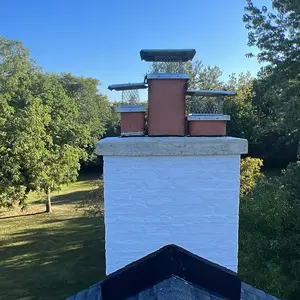
The Rebuilt Chimney After Exterior Work
The first selected project photo shows the completed exterior chimney after reconstruction and painting. The finished section presents a consistent exterior appearance while the chimney continues to serve several separate flue terminations.
Although the painted surface is visually prominent, the rebuilding underneath represents the structural portion of the work. After that, painting followed as the documented aesthetic finish for the repaired chimney.
Homeowners researching similar masonry work can review Chimney Monkey’s chimney rebuild and restoration service.
New Crowns and Rain Caps Protected the Chimney Tops
The project also included complete crown replacement on both exterior chimneys. Chimney B received a smaller full crown, while Chimney A required a larger crown sized for its structure.
In general, a concrete crown provides the upper weather-shedding surface around the flues. Its slope helps move precipitation outward, while the overhang and drip edge help direct runoff away from the vertical masonry walls.
In addition, the project included four stainless-steel rain caps. Chimney B received one cap, while Chimney A received three caps for its multiple flue terminations.
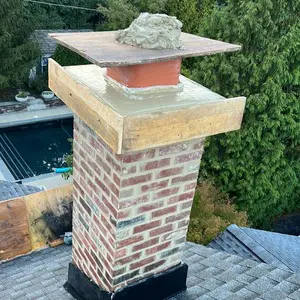
Concrete Crown and Chimney-Top Protection
Next, the second photo gives a close view of a completed chimney top. The concrete crown forms the broad surface below the termination, while the fitted cap protects the opening above it.
These components perform separate jobs. The crown manages water around the masonry top, whereas the rain cap helps reduce direct entry through the flue opening.
Flashing Resealing Addressed the Roof-to-Chimney Joint
Chimney B also received flashing resealing. Flashing protects the transition where the chimney passes through the roofing system, so it serves a different purpose from the crown above.
Consequently, repairing a crown does not automatically correct a roofline leak. Likewise, flashing work does not repair deteriorated masonry higher on the chimney.
The exterior project also required scaffolding or lift access. In other words, that access component reflects the practical requirements of completing masonry and chimney-top work safely around a tall roofline.
Why Chimney B Was Painted After Rebuilding
After reconstruction, the rebuilt section of Chimney B was painted to match the surrounding chimney or home. The invoice specifically treats this step as an aesthetic finish.
However, painting should not be confused with masonry waterproofing. In fact, the project documentation notes that painted brick loses some of its natural ability to release absorbed moisture.
Therefore, the paint belongs to the appearance portion of this project rather than the structural rebuilding or roofline water-management scope.
Fireplace A1 Required a Full Firebox Rebuild
Inside the home, Fireplace A1 required one of the most extensive repairs in the project: a full firebox rebuild. Unlike a targeted repair that preserves serviceable refractory masonry, this scope involved removing and replacing all refractory bricks that formed the firebox.
The firebox forms the interior combustion chamber where the fire itself burns. Consequently, damaged refractory masonry in this area requires materials and repair methods designed for high-temperature fireplace use.
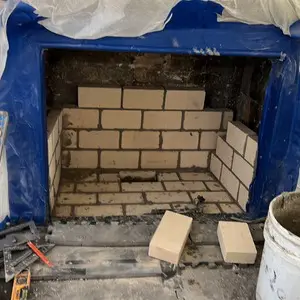
Rebuilding the Fireplace From the Firebox Out
The third project photo shows new refractory brick being installed inside the fireplace. Indeed, this view makes the difference between ordinary mortar repair and a true firebox rebuild especially clear.
Instead of patching selected joints, the full-rebuild scope creates a renewed refractory combustion chamber before the restoration continues upward into the smoke chamber and flue.
Chimney Monkey’s firebox repair and rebuild service provides additional information about refractory fireplace restoration.
Fireplace B1 Received Targeted Firebox Repair
Fireplace B1 had a different documented condition. Instead of replacing the entire firebox, the project called for refractory mortar repairs and replacement of cracked or broken refractory bricks as needed.
In short, this distinction illustrates why two fireplaces on the same property can receive different scopes. A1 required complete reconstruction, while B1 retained enough serviceable material for a more targeted repair.
Smoke-Chamber Parging Restored the Transition Above the Fireboxes
Both fireplace systems also received smoke-chamber repair. The smoke chamber sits between the firebox and the flue and funnels combustion products into the narrower chimney passage above.
Refractory parging seals documented gaps, cracks, or openings while smoothing the corbeled masonry surface. As a result, the repair creates a more continuous transition between the combustion chamber below and the liner above.
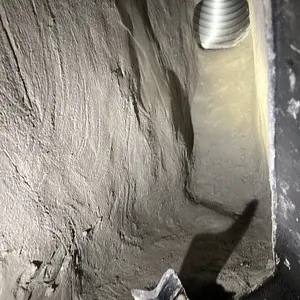
Refractory Material Inside the Smoke Chamber
The fourth image documents the smoke-chamber parging process. The masonry surface has been covered with refractory material to seal and smooth the transition above the fireplace.
This area becomes difficult to see after the fireplace is returned to normal use. Therefore, project photography helps document a repair that otherwise remains largely hidden inside the chimney system.
Two Stainless-Steel Liners Restored the Fireplace Flues
Above the smoke chambers, both fireplaces received continuous 11-inch stainless-steel liners. B1 required 21 feet of liner, while A1 required 27 feet.
In addition, the documented installation scope included clay-tile removal if needed, liner insulation, securing the stainless-steel system, and installing a new top tile.
Because the two fireplaces had different chimney heights and configurations, their liner lengths were not identical even though both used an 11-inch system.
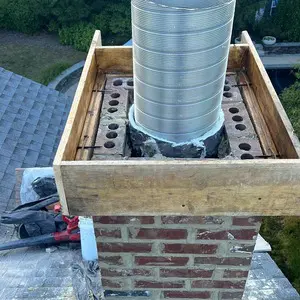
Creating a Continuous Interior Venting Path
Finally, the fifth photograph shows the stainless-steel liner during installation. Much of this component disappears inside the masonry chimney once the project is complete.
For that reason, liner photos are particularly useful in a project article. They show the actual material used to create the new venting pathway rather than relying on a generic diagram.
Chimney Monkey’s chimney liner service explains how liner sizing, insulation, inspection, and installation fit together.
How the Bannockburn Restoration Fits Together
At first glance, the exterior rebuild, crowns, rain caps, firebox work, smoke-chamber repairs, and stainless-steel liners may look like unrelated services. In practice, they restore different portions of connected chimney and fireplace systems.
01
Restore the Structure
First, rebuild exterior masonry that can no longer remain in service.
02
Protect the Exterior
Next, use crowns, flashing, and rain caps for their individual roles.
03
Restore the Fireboxes
Then, repair or rebuild refractory masonry according to each fireplace’s condition.
04
Restore the Vent Path
Finally, parge the smoke chambers and install the required stainless-steel liners.
Key Terms in This Project
- Chimney crown
- The sloped concrete surface on top of the masonry that sheds water away from the flues and chimney walls.
- Flashing
- The metal seal where the chimney passes through the roof, protecting the roof-to-chimney joint.
- Firebox
- The interior combustion chamber where the fire burns, lined with heat-resistant refractory brick.
- Refractory
- Brick and mortar made to withstand the high temperatures inside a fireplace.
- Smoke chamber
- The area between the firebox and the flue that funnels combustion products into the narrower chimney passage.
- Parging
- A refractory coating applied to the smoke chamber to seal gaps and smooth the corbeled masonry.
- Flue liner
- The inner channel that carries smoke and exhaust from the fireplace up and out of the chimney.
Frequently Asked Questions
What is a roofline chimney rebuild?
A roofline rebuild removes and reconstructs damaged exterior masonry above the roof while retaining suitable masonry below. However, the exact scope depends on the documented condition.
What is the difference between firebox repair and a full rebuild?
A repair preserves serviceable refractory masonry while correcting damaged joints or individual bricks. A full rebuild replaces the refractory bricks forming the complete firebox.
Why parge a smoke chamber?
Specifically, parging uses refractory material to seal gaps and smooth the transition between the firebox and flue. The repair addresses the smoke-chamber surface rather than the liner above it.
Why were the fireplace liners different lengths?
The B1 system required 21 feet of liner, while A1 required 27 feet. Chimney height and individual system geometry can differ even within the same property.
Why did Chimney A need three rain caps?
The invoice documents three fitted caps for Chimney A, indicating multiple flue terminations at that chimney top. Each cap protects an individual opening.
Professional Chimney Rebuild and Fireplace Restoration in Bannockburn
This chimney rebuild and fireplace restoration in Bannockburn shows how exterior masonry and interior fireplace repairs can form parts of one coordinated project.
Chimney B required roofline reconstruction, crown replacement, flashing work, painting, and a rain cap. Meanwhile, both fireplace systems received substantial interior restoration involving firebox work, smoke-chamber parging, and stainless-steel relining.
Ultimately, each component addressed a different part of the chimney system. The exterior masonry restored the structure, the crowns and caps helped protect the chimney tops, the firebox work restored the combustion areas, and the liners created continuous venting pathways through the flues.
Not sure what service your home needs? Start with a professional evaluation so the system can be identified, the visible conditions can be documented, and the right next step can be recommended.Have a question about your chimney, fireplace, venting system, gutters, or dryer vent? Schedule a professional visit and get clear recommendations based on the actual condition of your home.
Categories: Bannockburn Chimney Care Fireplace Services Lake County Illinois Local Services Masonry Chimney Repair Masonry Contractor Services