
How Can a Dryer Vent Be Serviced When a Ladder or Lift Cannot Reach It in Chicago?
In short: Rope-access dryer vent cleaning lets a trained technician reach a vent, gutter, or chimney. A ladder or lift can’t always reach these safely, especially in Chicago, where vents sit high above narrow gangways, alleys, or adjoining roofs. The technician rappels down the exterior of the building on rope instead. Before any rope work begins, the technician evaluates the roof and checks for a solid anchor point. Chimney Monkey offers this service across the Chicago area. The rope-access fee typically runs around $800, in addition to the cost of the service performed.
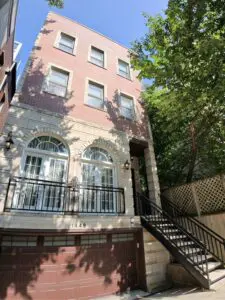
Many Chicago homeowners search for dryer vent cleaning near me. They often learn their vent sits three stories up, over a gangway between two brick two-flats. Lincoln Park, Lakeview, Wicker Park, and Bucktown are full of vintage multi-unit buildings built close to the property line. Their vents often exit above a narrow gangway where a ladder has no safe footing. Newer buildings in West Loop and South Loop create a different version of the same problem: tall facades with too little ground clearance for a lift. A rope-access approach may be the only practical way to reach it.
1. Why Are So Many Dryer Vents Difficult to Reach in Chicago?
Chicago’s building styles create most dryer vent access problems — the vent itself is rarely unusual. Three-flats and courtyard buildings sit close together, leaving only a narrow gangway between structures. That gangway is often too tight for a ladder to stand at a safe angle. Flat roofs and parapet walls also limit where a ladder can go. Many vents exit two or three stories up, over an alley, a neighbor’s roofline, or a fenced yard. Landscaping, utility lines, and fencing add even more obstacles that conventional equipment can’t work around.
2. Can a Dryer Vent Be Cleaned When a Ladder Cannot Reach It?
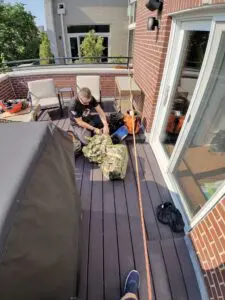
Yes. The ground below a dryer vent is sometimes uneven, too narrow, or too far from the wall. In that case, a ladder can’t stand there safely. A trained technician can instead use rope-access equipment to rappel from the roof and reach the vent directly. The technician works from a harness and rope system rather than standing equipment. This lets them clean, inspect, or repair the vent from a stable, anchored position — even where a ladder has no safe footing.
3. Can Technicians Rappel From a Roof to Access a Dryer Vent?
In many cases, yes, when a suitable anchor point exists at roof level. A trained technician evaluates the roof and any existing anchor hardware first, then rappels down to the vent, gutter, or chimney area. Not every roof or parapet wall qualifies as a suitable anchor. The crew evaluates the site before any rope work begins. Once the technician confirms a safe anchor, they descend with fall-protection equipment in place. They climb back up on belay when finished.
4. What Is Rope-Access Dryer Vent Cleaning?
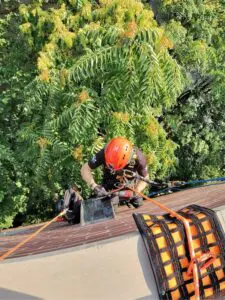
Rope-access dryer vent cleaning reaches exterior building components using ropes, a harness, and fall-protection hardware anchored at roof level. It replaces a ladder, lift, or scaffolding on buildings where those don’t fit. Industrial rope-access technicians and high-rise window washers use the same general technique. Chimney Monkey adapts it for dryer vent, gutter, and chimney work. A technician descends the exterior wall on a controlled rope system, completes the service, and climbs back up on belay. Because the setup depends on the building’s anchor points, every job starts with a site evaluation.
5. Is Rope Access Safer Than Leaning a Ladder Against a Difficult Building?
Not necessarily. Rope access isn’t inherently safer than a ladder or lift. It can be the more practical choice when a ladder has no safe footing or a lift can’t fit next to the building. Leaning a ladder against an unstable surface, or at too steep an angle, introduces real risk. A technician can set up rope access with a confirmed anchor point instead. This reaches the same area without ground contact. The right choice depends on the building and available options.
6. Why Might a Lift or Scaffolding Not Work in Chicago?
A bucket lift or scaffolding often won’t fit in Chicago simply because there isn’t room to set one up. Narrow gangways, fences, gardens, and utility lines can block the footprint a lift needs. Alleys are frequently too tight for a truck to maneuver into position. Parking restrictions, permit requirements, and uneven or paved-over ground can rule out scaffolding too. Condo or homeowners’ association rules may also restrict where crews can stage heavy equipment. That’s when rope access becomes worth evaluating.
7. What Types of Buildings Commonly Require Rappelling Access?
Vintage greystones, courtyard buildings, and three-flats built close to the lot line are frequent candidates for rope access. This shows up often in Logan Square, Ukrainian Village, Old Town, and Andersonville, where vents and gutters sit above narrow gangways. Taller condominiums in the Gold Coast, Edgewater, and Rogers Park can need rope access simply for their height. Buildings with steep or mansard-style roofs, or little side yard, come up often too. Each type still needs an individual review, since a suitable setup depends on the building and work area.
8. What Dryer Vent Services Can a Rope-Access Technician Perform?
A rope-access technician can typically perform exterior dryer vent cleaning and remove obstructions such as lint buildup. Where local rules allow it, they can also clear a bird nest from the vent opening. The technician can replace a damaged or missing dryer vent cover with an appropriate exterior cover. Removing a damaged vent hood is often part of that same visit. Many technicians also verify basic airflow and document the area with photos or video. The exact combination depends on what the building and vent actually need.
9. Can a Technician Replace a Damaged Exterior Dryer Vent Cover While Rappelling?
Yes, in most cases. Once a technician gets safely into position at the vent on rope, they can typically remove a missing, broken, or rusted exterior cover. They replace it with an appropriate new one in the same visit. The technician confirms the correct cover type and size ahead of time, since carrying the wrong part up or down mid-job isn’t practical.
10. Can Rope Access Also Service Gutters and Downspouts?
Yes. The same rope-access setup used for dryer vents can often clean gutters, clear downspouts, or install a downspout cover. This works particularly well on rooflines a ladder can’t safely reach. Gutter cleaning done this way follows the same evaluation process. The technician reviews the roof and anchor points first. Then they work down the relevant section rather than the whole perimeter at once.
11. Can a Technician Inspect a Chimney or Building Exterior While Rappelling?
Yes. While positioned on rope at or near a chimney, a technician can perform an exterior chimney inspection and check the chimney cap and surrounding flashing. This vantage point also gives a closer look at the masonry than the ground allows. This close-up view can surface issues — deteriorating mortar, a damaged cap, or loose flashing. These often aren’t visible from a ladder or the ground. Chimney Monkey typically scopes and quotes any repairs separately from the rope-access work itself.
12. How Much Does Rope-Access Service Cost in Chicago?
Rope-access service in Chicago typically includes a separate access fee of around $800. This fee covers the specialized equipment, roof-level setup, safety procedures, and extra technician time needed to reach the work area. It generally comes on top of the cost of the actual service performed. A project might include the $800 rope-access fee, for example, plus the normal cost of dryer vent cleaning, gutter cleaning, chimney inspection, or vent-cover replacement. This isn’t a fixed, guaranteed price — it reflects a typical project and can vary by site.
13. What Factors Affect the Cost of Rappelling Access?
Several factors can raise the cost above a typical project:
- ✓ Repositioning the ropes multiple times to reach different areas
- ✓ Accessing more than one elevation of the building
- ✓ Servicing multiple vents or downspouts in a single visit
- ✓ Requiring special roof protection during setup
- ✓ Needing additional technicians on site
- ✓ Limited or complicated anchorage that takes extra time to rig
- ✓ Coordinating access with neighbors, an association, or building management
- ✓ Needing multiple separate drops from the roof
Sharing building details up front helps Chimney Monkey produce a more accurate estimate.
14. Does the Rope-Access Fee Include the Dryer Vent Cleaning or Repair?
No. The rope-access fee covers reaching the work area safely. It doesn’t include the dryer vent cleaning, cover replacement, gutter cleaning, or chimney work itself. Chimney Monkey quotes and bills those services separately, the same as it would for a ground-level or ladder-accessible job. The access fee covers how the technician gets to the vent, not what the technician does once there.
15. How Should a Condominium Association Prepare for Rope-Access Service?
A condo or homeowners’ association can speed up the evaluation by sharing a few details in advance. Useful details include photos of the building’s exterior and roof, plus the approximate floor or height of the work area. Also helpful: information about existing roof access and the number of vents, downspouts, or chimneys needing service. It’s also worth flagging parking restrictions, shared alley access, or neighbor coordination the technician should know about. Buildings with multiple units often benefit from scheduling several components in one visit.
16. Who Should I Call for a Hard-to-Reach Dryer Vent in Chicago?
Chimney Monkey provides rope-access dryer vent cleaning, plus gutter and chimney service, throughout Chicago and the surrounding suburbs from its base in Buffalo Grove, Illinois. The company also handles exterior dryer vent and gutter work beyond rope access. Its technicians evaluate a building’s roof and access conditions. They then decide whether rope access, a lift, or a standard ladder setup is the right fit for the component in question.
Our Approach to Safety and Site Evaluation
Only technicians trained in fall-protection procedures perform rope-access work, using equipment rated for the job. That said, no access method — rope, ladder, lift, or scaffolding — removes all risk. Rope access isn’t automatically the right choice for every building. Every job starts with an evaluation of the roof, anchor points, weather, and the work required. The technician confirms the plan before going over the edge. When suitable anchorage isn’t available, Chimney Monkey recommends a ladder or lift instead.
Where Chimney Monkey Provides Rope-Access Service
Chimney Monkey serves Chicago property owners, condominium associations, and building managers throughout the city. That includes Lincoln Park, Lakeview, Wrigleyville, Logan Square, Bucktown, Wicker Park, Ukrainian Village, and Old Town. It also includes the Gold Coast, Andersonville, Edgewater, Rogers Park, Ravenswood, North Center, Roscoe Village, West Loop, South Loop, and Hyde Park. From its base in Buffalo Grove, the company also provides rope-access and standard chimney, dryer vent, and gutter service to North Shore suburbs. That list includes Evanston, Skokie, Wilmette, Winnetka, Glencoe, Highland Park, Glenview, Northbrook, and Deerfield.
Frequently Asked Questions
Can a dryer vent be cleaned by rappelling?
Yes. When a ladder or lift can’t safely reach a dryer vent, a trained technician can rappel from the roof using rope-access equipment. The technician first evaluates the roof and anchor points, then cleans the vent, removes obstructions, or replaces a damaged cover.
How much does rope access cost?
Rope-access service typically includes a separate fee of around $800. It covers the specialized equipment, roof-level setup, and technician time needed to reach the work area. This is generally on top of the cost of the dryer vent cleaning, gutter cleaning, or repair itself.
Is the $800 access fee the total service price?
No. The approximately $800 access fee covers reaching the work area only. Chimney Monkey quotes and bills the dryer vent cleaning, cover replacement, gutter cleaning, chimney inspection, or repair separately, the same way it would price a standard, ladder-accessible job.
Can you replace a dryer vent cover while on ropes?
In most cases, yes. Once a technician gets safely into position at the vent, they can typically remove a damaged or missing exterior cover. They replace it with an appropriate new one in the same visit, once the correct cover type has been confirmed ahead of time.
Can you clean gutters using rope access?
Yes. The same rope-access setup used for dryer vents can often clean gutters, clear downspouts, or install a downspout cover. This works well along rooflines a ladder can’t safely reach, following the same site-evaluation process used for other exterior work.
Can ropes be anchored to a parapet wall?
Sometimes, but not automatically. A parapet wall may serve as a suitable anchor point, depending on its construction and condition. A technician must evaluate it on-site first. Not every parapet wall or roof feature actually qualifies as a safe anchor for rope work.
Do you service condominium buildings?
Yes. Chimney Monkey works with condominium associations and building managers throughout Chicago. The team often coordinates directly with the association on roof access, scheduling, and any building-specific restrictions the property may have, both before the visit and once the work is complete.
Can you work over a narrow Chicago gangway?
Often, yes. Narrow gangways between buildings are one of the most common reasons a ladder or lift won’t work in Chicago. They’re a frequent scenario for rope-access work: a technician descends from the roof to reach a vent or gutter sitting above the gangway.
Can you inspect a chimney while rappelling?
Yes. While positioned at or near the chimney on rope, a technician can visually inspect the chimney cap, flashing, and visible masonry. They then document the condition with photos or video. Chimney Monkey typically scopes and quotes any repairs found during the inspection separately from the access work.
What information is needed before scheduling?
Helpful details include the property address, photos of the building, and the specific vent or work area, plus the approximate floor or height involved. Also useful: information about existing roof access, the number of vents or components needing service, and any parking, alley, or association restrictions.
Get a Rope-Access Evaluation for Your Chicago Property
A conventional ladder or lift can’t always reach a dryer vent, gutter, chimney, or exterior component. When that happens, contact Chimney Monkey for an access review. Property owners, associations, and building managers can speed things up by providing:
- ✓ The property address
- ✓ Photos of the building
- ✓ Photos of the vent, gutter, or work area
- ✓ The approximate floor or height involved
- ✓ Information about existing roof access
- ✓ The number of vents or work areas needing service
- ✓ Any parking, alley, neighbor, or association restrictions
Chimney Monkey will review the access conditions and let you know whether rope-access service may be appropriate.
Not sure what service your home needs?
Start with a professional evaluation so the system can be identified, the visible conditions can be documented, and the right next step can be recommended.
Have a question about your chimney, fireplace, venting system, gutters, or dryer vent?
Schedule a professional visit and get clear recommendations based on the actual condition of your home.
Categories: Chicago Illinois Chimney Exterior Services Chimney Inspection Dryer Vent Local Services Masonry Chimney Repair