

Inside a Natural Stone Tuckpointing and Damper Repair Visit in Glenview
Natural stone tuckpointing removes failing mortar from between stone joints and replaces it with fresh material. The job looks different on natural stone than it does on brick. Chimney Monkey is a National Fireplace Institute–affiliated company rated 4.9 stars across more than 1,100 reviews. Our crew recently repointed mortar joints at several spots around a natural stone home in Glenview, IL. During the same visit, they also replaced three worn damper handles.
This post covers what stone tuckpointing involves and why it differs from brick work. It also covers why a small damper repair sometimes rides along with a masonry visit. Last updated September 2026.
What Is Tuckpointing, and Why Does Natural Stone Change the Job?
Mortar sits between masonry units on purpose. It is meant to wear out before the stone or brick does. Rather than serve as a permanent glue, it acts as a flexible bedding layer. As a result, tuckpointing cuts out that failing mortar and packs in fresh material. That keeps a wall shedding water instead of soaking it up. Brick and natural stone do not always take the same mortar mix. A mortar that is stronger than the masonry around it will not flex. The stress then has to go somewhere else, usually cracking or spalling the stone or brick instead of the joint. Soft, older brick generally needs a softer, lime-based mortar. In contrast, natural stone is typically harder and can often tolerate a stronger mix. Even so, the exact formula still depends on the specific stone. Ultimately, getting that match wrong can damage masonry that costs far more to fix than a joint would have.
What This Tuckpointing Job Involved in Glenview
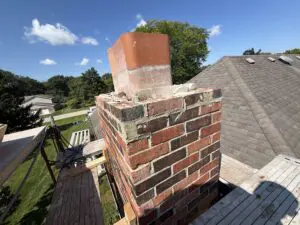 This is a large natural stone home with mortar joints showing wear in several places. Our crew found deterioration at foundation corners, beneath window and door lintels, and along a garage-door surround. Next, they removed the failing mortar at each spot and repointed it with a matched mix. Then they tooled the new mortar to blend with the home’s existing joint profile. Wear showing up in multiple locations on one property is a pattern, not a coincidence. After all, the same age, weather exposure, and original mortar mix affect every joint on a house at roughly the same pace. When one area starts failing, others are often not far behind.
A Bundled Repair: New Damper Handles in the Same Visit
While the crew had access to the fireplace, they also replaced three worn damper handles. The originals showed heavy rust and wear from years of use. That kind of small hardware failure is easy to miss until a handle stops holding the damper in place. In fact, a damper that will not stay open or closed causes problems either way. For instance, it can leave a fireplace drafting when it should not, or unable to seal properly. Functioning handles matter more than their small size suggests. Bundling a small repair like this into a bigger visit is common practice. Once a technician already has access to an area, fixing a minor issue on the spot is easy. It also usually costs less than scheduling a separate visit later.
How Professionals Approach a Tuckpointing Job Like This One
A repointing job generally follows the same sequence, whatever the masonry:
- Inspect each joint and mark the sections where mortar has failed.
- Grind or cut out the deteriorated mortar to a sufficient depth, generally two to two-and-a-half times the joint’s width. That lets the new mortar bond properly instead of popping back out.
- Clean out dust and debris, then dampen the joint before repointing.
- Pack in mortar mixed to match the original in strength, color, and composition.
- Tool the new mortar to match the wall’s existing joint profile.
Skipping the depth step is one of the most common shortcuts on a rushed repointing job. A thin skim coat over failing mortar can look fine for a season or two, then falls right back out.
Typical Cost Ranges for Tuckpointing and Damper Repair
Exact pricing depends on the masonry type, joint condition, and access. The figures below are general market ranges, not a quote for any specific home:
| Service | Typical Range | What Affects the Price |
|---|---|---|
| Brick tuckpointing | Roughly $7–$10 per brick | Joint depth, mortar match, and access |
| Natural stone tuckpointing | Roughly $1,500–$4,500+ per project | Number of locations, joint size, and stone type |
| Damper handle replacement | Roughly $75–$200 | Number of handles and accessibility |
| Chimney inspection | $200 to $300 (rates as of September 2026) (Level 1) or around $300 (Level 2) | Scope of inspection needed |
These ranges reflect general market pricing for the Chicago North Shore area. They are not a quote. A firm price requires an on-site or photo-based evaluation of your specific home.
Signs Your Stone or Brick Home May Need Tuckpointing
- Mortar that crumbles or comes out as loose sand when you touch a joint.
- Visible cracks running through joints, especially below window sills and lintels.
- Daylight or drafts visible through a joint from an unfinished space, like a garage.
- White, chalky staining on the masonry surface, known as efflorescence.
- Damp or discolored interior walls near an exterior masonry wall after rain.
- Small hardware, like damper handles or caps, that has gone stiff, rusted, or stuck with age.
Any single sign is worth a look. Several signs appearing together are a stronger reason to act. In particular, this Glenview home showed wear in more than one spot. That’s why we checked the whole exterior instead of patching a single location.
Frequently Asked Questions
What is tuckpointing, exactly?
It is the process of removing deteriorated mortar from between masonry units and replacing it with fresh, matched mortar. Done correctly, it also restores the wall’s ability to shed water and protects the masonry underneath.
Why does natural stone need different mortar than brick?
Brick and natural stone often call for different mortar mixes. Mortar is designed to be the sacrificial part of a wall. It wears out before the masonry itself does, so it needs to stay softer than whatever it sits between. Older brick is usually soft and needs a gentle, lime-based mix. By comparison, harder natural stone can often tolerate a stronger blend. Using the wrong mix in either direction can crack the masonry instead of just the joint.
How deep should old mortar be removed before repointing?
A common guideline calls for removing old mortar to a depth of about two to two-and-a-half times the joint’s width. Anything shallower tends to fail early, since a thin skim coat cannot bond as well as a properly-cut joint.
Does a cracked joint always mean the whole wall is failing?
No. A single cracked joint can be a localized issue. But one area of masonry usually ages at close to the same rate as the rest. Instead, cracking in one spot is a reasonable prompt to check nearby joints too, rather than assume it’s isolated.
Why would a damper handle need replacing?
Damper handles take years of heat, moisture, and use. Once one rusts or wears down, it can stop holding the damper securely open or closed. In turn, that affects how well a fireplace drafts and seals when it’s not in use.
Can tuckpointing and a damper repair really happen in the same visit?
Yes. Technicians are already on-site and set up, so fixing a small, unrelated issue in the same trip is common. It’s usually more efficient than scheduling and traveling for a separate visit later.
How long does a multi-location tuckpointing job take?
It depends on how many joints need attention and how spread out they are across the property. A project touching several separate areas, like this one, is often a full day or more. In addition, access and mortar-matching both factor into the total time.
How much does tuckpointing cost?
Brick tuckpointing is often priced per brick, roughly $7–$10 each. Natural stone tuckpointing is usually priced by project instead, since stone units vary so much in size. See the cost section above for a fuller breakdown, and request an on-site evaluation for an exact figure.
Not sure whether your home needs natural stone tuckpointing, a hardware fix, or something else? Start with a professional chimney inspection so every joint and piece of hardware can be checked in one visit.
Have a question about your chimney, fireplace, venting system, gutters, or dryer vent? Schedule a professional visit and get clear recommendations based on the actual condition of your home.
Categories: Chimney Exterior Services Cook County Illinois Glenview Local Services