
Inside a Custom Rain Cap Installation for a Clay Chimney Topper in Winnetka
A chimney rain cap keeps water, animals, and debris out of an open flue. When a chimney already wears a decorative clay topper, a plain off-the-shelf cap rarely fits or matches it. Chimney Monkey is a National Fireplace Institute–affiliated company rated 4.9 stars across more than 1,100 reviews. Our crew fitted a custom, black powder-coated cap to a clay topper on a two-flue chimney in Winnetka, IL. They also flagged a separate issue for the homeowner to consider next.
This post walks through what a custom cap job involves and why a clay topper changes the approach. It also covers what the crew found along the way. Last updated September 2026.
What Is a Custom Rain Cap, and Why a Clay Topper Changes the Job?
It sits on top of a flue and keeps out rain, snow, birds, and debris. Smoke and gases still vent normally through it. Most flues take a standard square or round cap sized to one of a handful of common openings. A clay chimney topper is different. Many older and architecturally detailed homes have one of these decorative terracotta pieces capping the flue. Builders added it for looks as much as function. A standard cap often will not seat correctly on that shape. Custom fabrication solves the mismatch. A technician measures the existing topper directly, then has a cap built to match its profile and diameter. Material choices include plain or powder-coated stainless steel, or copper for a living-metal finish that changes color over time. Style matters too. The new cap sits beside a topper that is already a visible, decorative roofline feature, not a hidden utility part.
What This Rain Cap Installation Involved in Winnetka
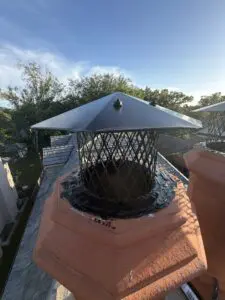
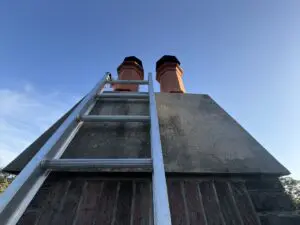 This chimney carries two flues, each finished with its own clay topper. Our crew installed a custom, black powder-coated metal cap fabricated to match one topper’s style and dimensions. Reaching the chimney top called for a 48-foot ladder. Raising, securing, and supporting equipment that size safely also took extra hands. The finished cap sits directly on the clay topper, blending with the roofline instead of standing out. Custom fabrication takes more coordination than a stock cap does. A technician cannot simply pull a cap off a shelf and expect a clean fit. Measurements have to account for the topper’s exact shape. The finish also has to hold up outdoors through Chicago winters, well above the ground.
Why a Rain Cap Matters for Any Chimney
A cap protects more than the flue opening. It blocks rain and snow from soaking into brick and flue liner, and keeps birds and squirrels from nesting inside. It also reduces downdrafts, which can otherwise push smoke back into the house. And it helps contain sparks and embers so they do not land on the roof. Without a cap, an open flue leaves every one of those risks unaddressed, whether the topper is plain or decorative. None of that protection depends on the cap being custom. A standard cap does the same core job on a standard flue. Custom work only becomes necessary once the topper’s shape, or a homeowner’s aesthetic goals, rule out an off-the-shelf option.
What the Inspection Also Found: A Cracked Chimney Crown
While the crew had safe access to the chimney top, they also checked the crown. This concrete cap spans the top of the masonry and sheds water away from the structure. They found several cracks. The crown works as the first line of defense against rain, snow, and ice at the top of a chimney. Its job is to keep moisture out of the brick and mortar below. Cracks let water in instead. Even a small one can widen through freeze-thaw cycles into costlier water damage. Based on the inspection, resurfacing the crown is a recommended next step, not work completed during this visit. Depending on how far the cracking has progressed, that can mean sealing the surface to stop water intrusion. More advanced damage may call for rebuilding the affected sections instead. A CSIA-trained inspector checks the crown and its flashing as a standard part of a masonry fireplace inspection.1 The cap and the crown are separate systems. A homeowner can address the crown on its own timeline, though waiting rarely makes that repair smaller or less expensive.
How Professionals Size, Fabricate, and Install a Custom Cap
Fitting a cap to a clay topper generally follows the same sequence from job to job:
- Measure the topper’s exact shape, diameter, and height at the chimney top.
- Choose a material based on budget, finish, and how it needs to weather over time.
- Fabricate the cap to match those measurements and the home’s style.
- Set up ladder or scaffolding access sized to the chimney’s height.
- Install and secure the cap, then confirm it does not restrict airflow out of the flue.
Skipping the measurement step is the most common way a cap ends up not fitting. A cap built to a generic size might sit on top of the topper without actually sealing or matching it. That defeats much of the point of going custom in the first place.
Typical Cost Ranges for Rain Caps and Crown Work
Exact pricing depends on chimney height, access difficulty, and the materials involved. The figures below are general market ranges, not a quote for any specific home:
| Service | Typical Range | What Affects the Price |
|---|---|---|
| Standard cap installation | Roughly $320–$500 | Flue size and material (stainless steel vs. copper) |
| Custom or decorative rain cap | Roughly $700–$1,800 | Custom fabrication, topper style, and material |
| Multi-flue cap installation | Roughly $800–$1,000+ | Number of flues and access difficulty |
| Extended ladder or roof access | Roughly $200–$650 | Chimney height and equipment needed |
| Crown sealing or resurfacing | Roughly $400–$1,200 | Extent of cracking and crown size |
| Full crown rebuild | Roughly $1,800–$3,800 | Chimney size and extent of existing damage |
These ranges reflect general market pricing for the Chicago North Shore area. They are not a quote. A firm price requires an on-site or photo-based evaluation of your specific chimney.
Signs Your Chimney Cap or Crown May Need Attention
A few warning signs are worth having evaluated:
- No cap at all on an open flue, or a cap that looks bent, rusted, or loose.
- Scratching, chirping, or nesting sounds coming from inside the chimney.
- Water stains on the ceiling or wall near the chimney after rain.
- Visible cracks across the crown’s surface, seen from the ground or a nearby window.
- A whistling sound or a steady downdraft when the flue is open.
- An older clay topper that looks chipped, worn, or mismatched with its cap.
Any single sign is worth a look. Several together are a good reason to schedule a full chimney inspection instead of treating one symptom at a time. This Winnetka chimney showed both a topper needing a proper cap and a crown starting to crack.
Frequently Asked Questions
What does a chimney rain cap actually do?
It keeps rain, snow, birds, and debris out of the flue while smoke and gases still vent normally. It also helps reduce downdrafts and contains sparks so they do not land on the roof.
Why can’t a standard rain cap just sit on top of a clay chimney topper?
A clay topper has its own shape and diameter. Standard caps are sized for common flue openings, not for that decorative piece. A cap that does not match the topper’s profile may not seal right, or it may look out of place. That mismatch is why these jobs usually call for custom fabrication.
What materials are custom rain caps made from?
Stainless steel, plain or powder-coated, is the most common choice and holds up well outdoors. Copper is a premium option that develops a natural patina over time. Galvanized steel is available too, but it typically wears out faster, often within about a decade.
Does installing a new rain cap fix a cracked chimney crown?
No. A cap protects the flue opening. The crown is a separate concrete cap that seals the top of the masonry itself. Both matter, but fixing one does not address damage to the other.
How urgent is a cracked chimney crown?
It depends on how extensive the cracking is. Even small cracks can let water in, and they tend to widen over time through freeze-thaw cycles. It is worth scheduling an evaluation rather than waiting for visible damage to spread.
How do professionals reach the top of a tall chimney for this kind of work?
The equipment depends on the chimney’s height and the roof’s pitch. Some jobs need a long extension ladder and an extra technician, like the 48-foot ladder used on this Winnetka chimney. Taller or steeper chimneys may call for scaffolding instead.
How long does a custom rain cap installation take?
Once the cap is fabricated to the measured specifications, installing it is usually a same-day visit. The measuring and fabrication step can add time upfront if the cap is not a stock size.
How much does a custom or decorative rain cap cost?
Standard caps typically run $320–$500. Custom or decorative caps cost more, since matching a clay topper needs measurement and fabrication, not an off-the-shelf part. See the cost section above for a fuller breakdown, and request an on-site evaluation for an exact figure.
Not sure what your own chimney needs? Start with a professional evaluation so the cap, crown, and flue can all be checked together. That way, any recommendations are based on what is actually found.
Have a question about your chimney, fireplace, venting system, gutters, or dryer vent? Schedule a professional visit and get clear recommendations based on the actual condition of your home.
1 Chimney Safety Institute of America, Level 2 Inspection Checklist for a Masonry Fireplace (accessed September 2026).
Categories: Chimney Cap Local Services Winnetka