
Pigeon-Proofing Fourth-Floor Downspouts in Old Town, Chicago
A four-story brick building on North Wieland Street, three downspouts full of nesting material, and gangways too narrow for a lift. We rigged from the roof and went down the wall.
Pigeons had moved into the conductor heads at the top of three fourth-floor downspouts on a brick building in Old Town, Chicago. Old Town lots sit close enough together that there is no room for a boom lift and no ladder that reaches, so Chimney Monkey technicians anchored two ropes on the roof, rappelled down the facade, cleared the nests, and fastened fabricated stainless steel screens over all three openings. Typical cost for work like this runs $200–$300 per screen plus an $800–$1,000 rope access setup — roughly $1,400–$1,900 for three openings on one rig.
The call
Birds in the downspouts, and nobody could get to them
The complaint was specific, which is usually a good sign. The owner could hear the birds through the wall of the top-floor unit, and they had also started working their way in under the fourth-floor porch. This is a familiar pattern in Old Town: a well-maintained brick building where the only neglected square footage is the part nobody can physically reach.
Every downspout on this building starts at an open conductor head — the sheet-metal box at the top of the run that catches water off the gutter and funnels it into the pipe. To a rock pigeon, that box is close to ideal. High walls, a solid floor, a roof over it, and forty feet of air between the nest and anything on the ground. Rock pigeons nest in ledge cavities by instinct, and a conductor head is the closest thing a city building offers.
Left alone through one season, the box fills with nesting material until the downspout stops draining. Then the overflow starts running down the brick instead of through the pipe, and a bird problem quietly turns into a masonry problem. Saturated brick and mortar going through Chicago’s freeze–thaw cycles is the same mechanism that takes apart chimney crowns and parapets.
Clearing the nests, by itself, fixes nothing. The birds return to the same opening within days, because the opening is what they selected. The only durable fix is to close the opening to birds while leaving it completely open to water.
The access problem
Fourth floor, and nowhere to put a lift
The three openings sat more than forty feet up. Old Town and the surrounding Near North Side were platted long before anyone needed to park a boom lift: the gangway between these buildings fits a person and not much else, the alley has no staging room, and there are mature trees tight against the wall. A lift has nowhere to set up and nothing to reach over. Scaffolding for three screens would have cost several times the repair itself, tied up the walkway for a week, and needed permits.
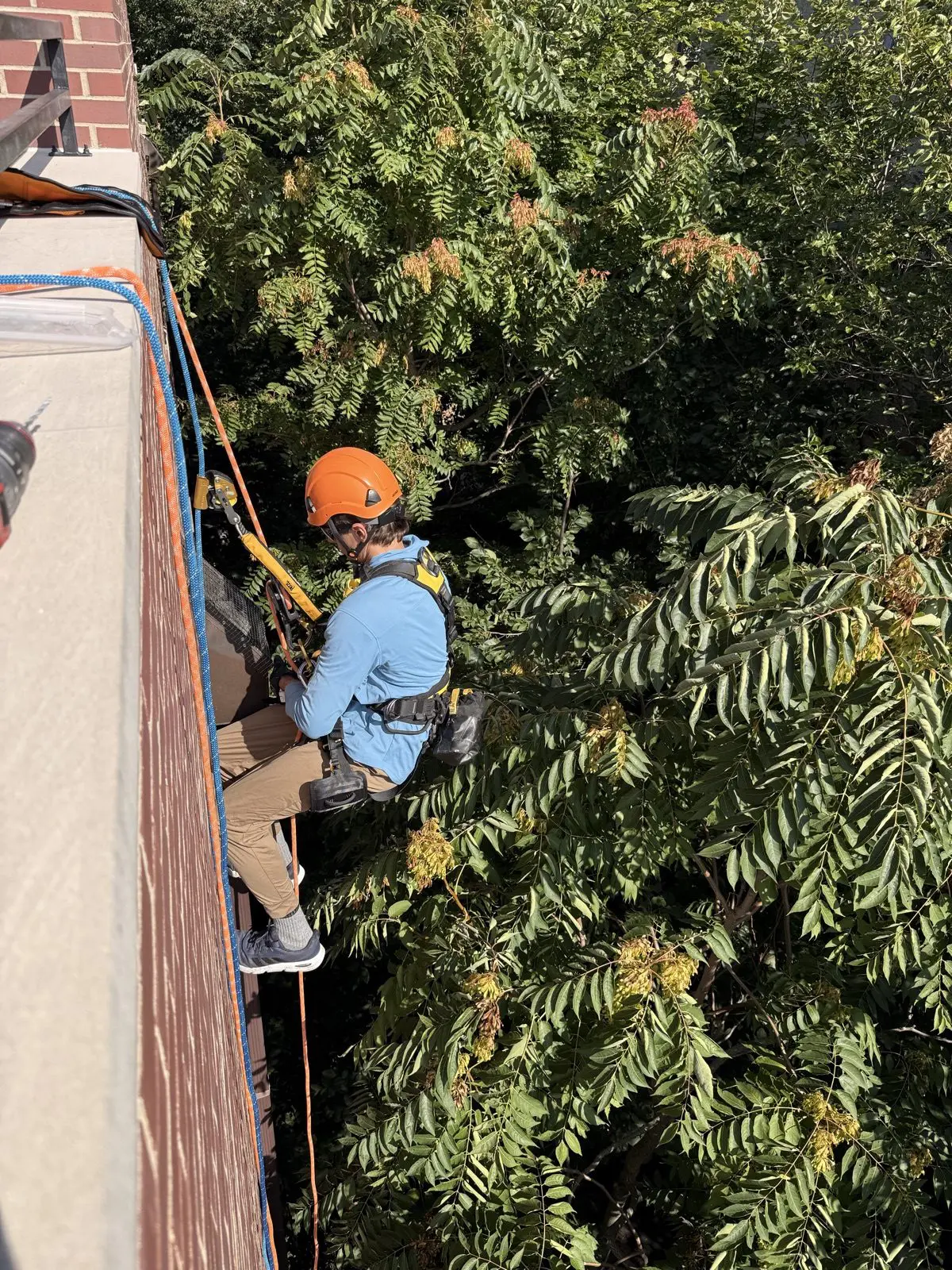
Rope access solves a different problem. It needs a roof and a sound anchor point rather than a parking spot. Our technicians rigged from the roof, worked down the face of the building, and reached each conductor head directly — no equipment on the ground, nothing blocking the neighbors, finished in a day.
How it was done
Rigged from the roof, installed on rope
- Anchors set and inspected. Two independently anchored lines per technician — a working line and a backup line — rigged and checked on the roof before anyone goes over the edge.
- Edge protection at every contact point. The parapet coping and roof edge are padded so the rope never bears on a hard corner, and so the building’s stone and roof membrane are not marked by the descent.
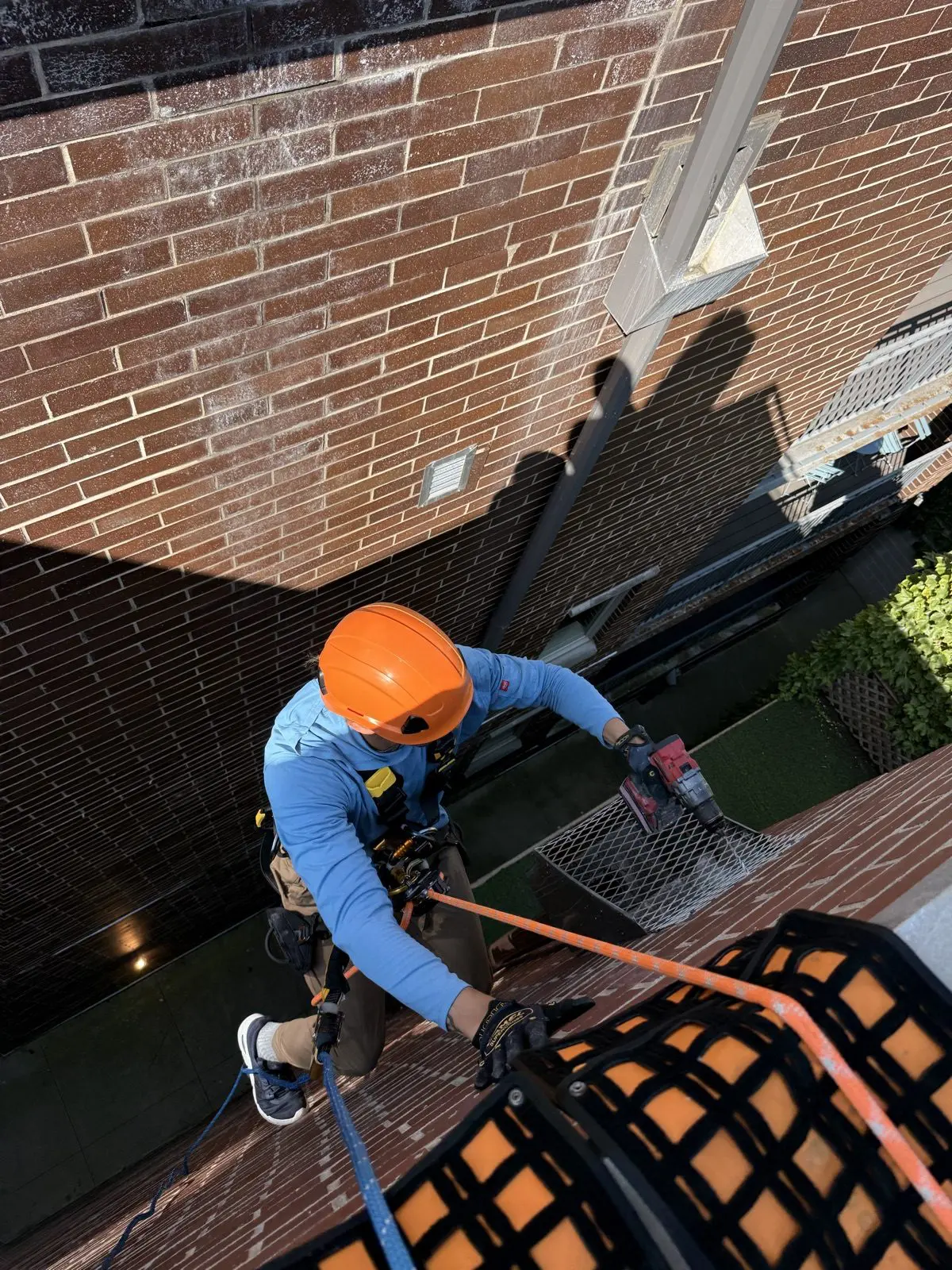
- Descent to each opening. The technician rappels to the conductor head and ties off in a working position, which frees both hands at the work. Same industrial technique used on high-rise facades, applied to a four-story building.
- Nests cleared, openings measured. Each head was cleared and measured in place. Sizes vary from one downspout to the next even on a single building, so nothing is fabricated off an assumption.
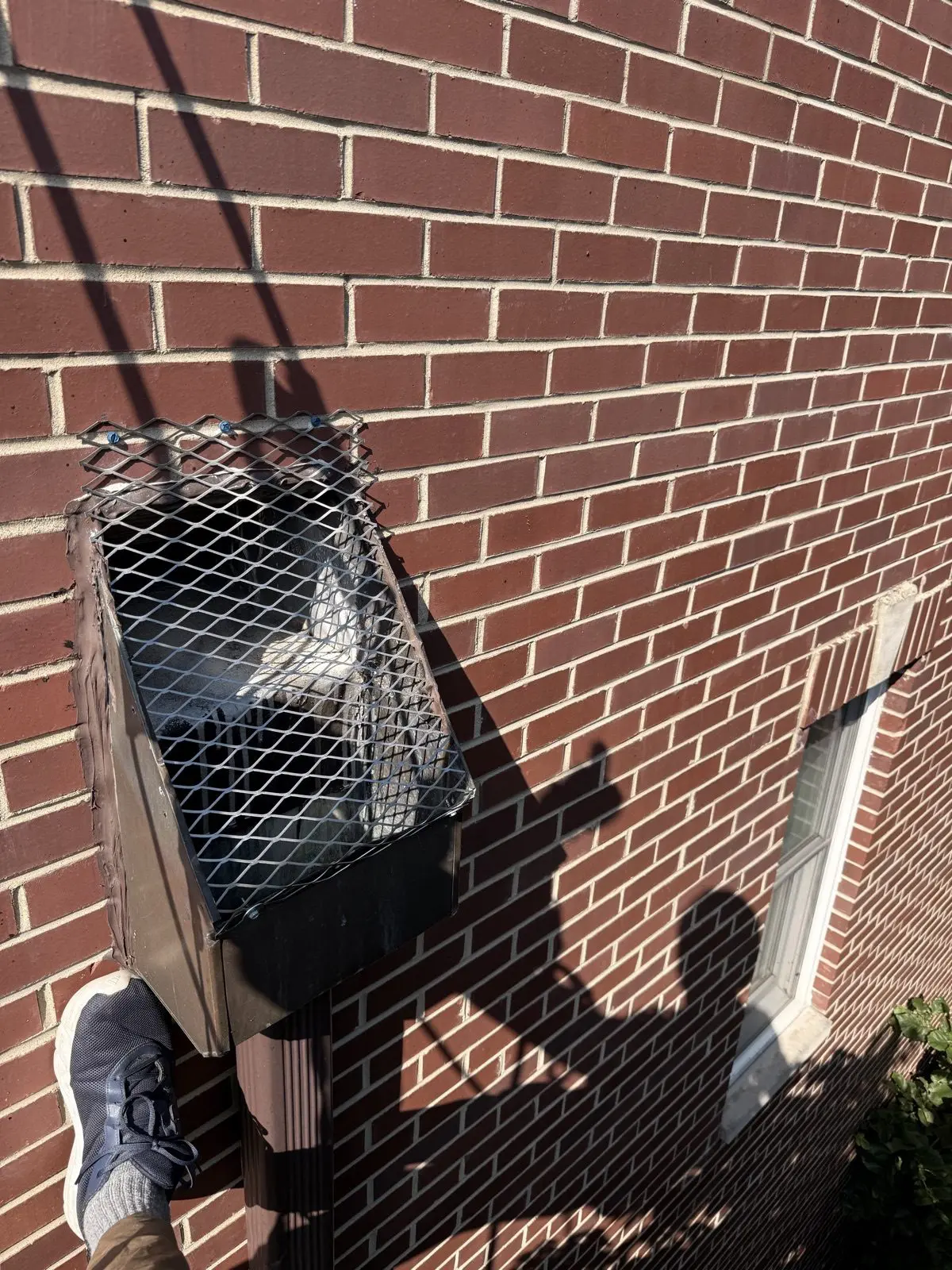
- Stainless screens fitted and fastened. Each screen is a formed hood of expanded stainless steel mesh, set over the opening and fastened to the sheet metal and the mortar joints so it cannot be lifted by wind or worked loose at the edge.
- Photographed before and after. Every opening was documented from the rope. The owner can see exactly what was up there and exactly what is there now — the same documentation standard we hold on a chimney inspection.
Photos
The job, from the roof down
Every opening on the building was photographed from the rope, before and after.






The detail
What the screens are, and why they don’t cause overflow
Each screen is expanded stainless steel mesh, formed into a five-sided hood and fitted over the mouth of the conductor head. Stainless because it sits in standing water and Chicago road salt for decades and cannot be the part that fails. Expanded mesh because it is rigid enough to hold its shape without a frame, and open enough that it does not restrict flow.
The usual worry is that a screen becomes a clog. It does not, as long as it is sized correctly. The hood is fabricated larger than the opening it covers, so the total open area of the mesh is several times the cross-section of the downspout throat below it. Water never sees the mesh as a restriction — the pipe is the bottleneck, and it always was. What the mesh stops is anything too big to pass through it: birds, nesting material, and the leaf litter that used to wash straight into the pipe.
Fastening matters as much as the mesh. Screws through the flange into the sheet metal head and into the mortar joints mean the screen cannot be lifted by wind, and a bird working at the edge finds nothing that gives. The gutters and downspouts run exactly as they did before. The birds have moved on — which, from a pigeon’s point of view, is the whole complaint.
What it costs
What a job like this runs in Chicago
Two numbers drive the price of any bird-proofing job above ladder height: the covers themselves, and getting a person to them.
| Item | Typical |
|---|---|
| Stainless screen, per opening Fabricated to the opening, fitted and fastened | $200–$300 |
| Rope access setup Rigging, edge protection and rappelling at one location on the building | $800–$1,000 |
| Three openings on one rig, as on this job | $1,400–$1,900 |
The setup charge is the part people don’t expect, and it is the one that should shape how the work is planned. Rigging takes the same effort whether the technician installs one screen or eight. A single opening carries the entire access cost by itself; a whole building splits it across every opening. If the ropes have to be moved to a different elevation to reach the far side of a building, expect a second setup charge.
The practical takeaway: if birds are in one downspout, they will be in the others by next spring. Screening every opening on one descent is usually the cheaper decision, not the more expensive one, and it is the only version of this job that does not need doing again.
These are typical planning ranges, not a quote. Height, the number of elevations, the number of openings, and roof anchoring all move the number. Firm pricing follows a look at the building.
Questions
Common questions
How much does it cost to install bird screens on downspouts?
Budget roughly $200 to $300 per screen for a stainless steel cover fabricated to the opening, fitted and fastened. A job above ladder height also carries a rope access setup charge, typically $800 to $1,000, covering rigging and rappelling at one location on the building. On this Old Town job, three screens plus one rope setup landed in the $1,400 to $1,900 range.
Do downspout bird screens block water or cause overflow?
Not when they are sized correctly. The screen is fabricated larger than the opening it covers, so the total open area of the mesh is several times the cross-section of the downspout throat below it. The pipe is the bottleneck, not the screen. Water passes at full flow; the mesh only stops what is too big to fit through it.
Why do pigeons nest in downspouts and gutters?
An open conductor head is a sheltered box with high walls, a solid floor and a roof overhead — close to the rock ledge cavity a rock pigeon nests in naturally. Upper floors are also the least disturbed part of a building, so a nest goes unnoticed until the downspout stops draining, the overflow starts running down the brick, or the noise reaches the top-floor unit.
Can you reach a fourth-floor downspout without a lift or scaffolding?
Yes. Rope access anchors at the roof and works down the face of the building, so it needs a roof and an anchor point rather than staging room on the ground. On Old Town and Near North Side lots where the gangway is too narrow for a lift and the alley has no room, it is often the only practical way to reach an upper-floor opening.
Will just removing the nest solve it?
No. Clearing a nest out of a conductor head buys a few days. The birds come back to the same opening because the opening is what they chose. Closing the opening to birds while leaving it open to water is what actually ends it.
Does Chimney Monkey work in Chicago proper, or only the North Shore?
Both. We are based in Buffalo Grove and work throughout Chicago’s North Shore — Deerfield, Northbrook, Glenview, Winnetka, Wilmette, Glencoe, Highland Park, Lake Forest, Lake Bluff, Highwood, Evanston and Skokie — and we take rope access and exterior work in Chicago neighborhoods like Old Town and the Near North Side.
Birds above ladder height?
If something is nesting in a downspout, a gutter, a chase or a flue that you can’t get to, we can tell you what is up there and what it takes to close it. Our technicians are trained and equipped for rope access work, and the photos come back to you either way.
Chimney Monkey has been working on chimneys, fireplaces, masonry and exteriors since 2017, with masons and inspectors on staff and more than 1,100 Google reviews.
Call 847-994-4388Serving Old Town, the Near North Side and Chicago’s North Shore — Buffalo Grove, Deerfield, Northbrook, Glenview, Highland Park, Lake Forest, Lake Bluff, Winnetka, Wilmette, Glencoe, Highwood, Evanston and Skokie.
Categories: Chicago Illinois Cook County Illinois Gutter Cleaning Local Services